
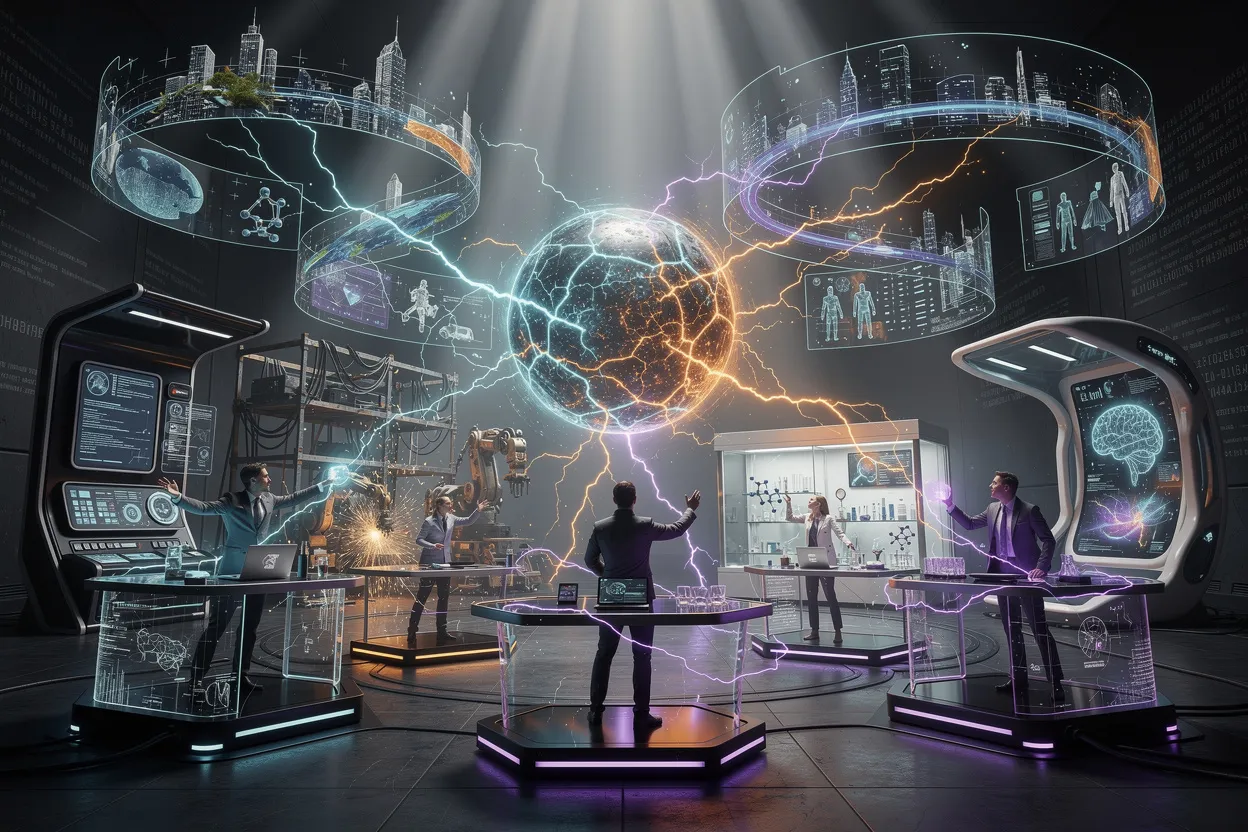
Six leaders, six colossal fortunes, six irreconcilable visions of what artificial general intelligence (AGI) will become. Who is right? The answer to this question is worth trillions of dollars and may determine the future of our species.
This article compares their visions across 7 key dimensions: timeline, definition of AGI, technical architecture, priority applications, risk management, societal philosophy, and business strategy.
- Sam Altman promises AGI by 2027.
- Yann LeCun claims we won’t get there for decades with current approaches.
- Elon Musk is building the largest compute cluster ever conceived.
- Dario Amodei is betting on safety as a competitive advantage.
- Mark Zuckerberg is all-in on radical open source.
- Demis Hassabis, awarded a Nobel Prize for AlphaFold, sees AGI as a catalyst for scientific discovery.
The years 2026-2027 are shaping up to be decisive: at least one of these visions will be validated or refuted.
Comparison Table: 6 Visions, 6 Trajectories
| Leader | AGI Timeline | Approach | Focus | Risks | Model |
|---|---|---|---|---|---|
| Sam Altman | 2027-2028 | Scale + o-series | Productivity | Moderate | Closed/API |
| Elon Musk | 2026 | Massive compute | Robotics | High (20%) | Hybrid |
| Dario Amodei | 2026-2027 | Constitutional AI | Safety | Very high | Closed |
| Demis Hassabis | 2028-2030 | World Models + Multi-systems | Science | Non-zero | Hybrid/Google |
| Mark Zuckerberg | Not a priority | Open source | Social/AR | Low | Open |
| Yann LeCun | Decades | JEPA/World Models | Research | Skeptical | Academic |
Sam Altman: The Prophet Of Acceleration
Core Thesis
Co-founder of OpenAI and the most publicized figure in the AGI race, Sam Altman embodies the optimistic-urgent stance.
His thesis in one sentence: AGI will arrive before 2030, probably around 2027, and will transform civilization positively—if we prepare for it properly.
Timeline And Definition
Altman has gradually shortened his predictions. In 2023, he talked about “a few years.” In early 2025, he mentioned 2027–2028 as the likely horizon.
His definition of AGI remains deliberately vague: a system capable of performing the majority of intellectual tasks a human can do, with a measurable economic impact, roughly $100 billion in generated revenue.
Technical Architecture
OpenAI’s strategy is built on three pillars: scaling transformers (GPT-5 expected in 2025), the o-series (o1, o3, o4-mini) introducing “reasoning at inference time,” and increasingly autonomous agent capabilities.
OpenAI is investing massively in infrastructure, notably through Project Stargate ($500 billion over 4 years).
Priority Applications
Altman targets large-scale cognitive productivity. ChatGPT has 400 million weekly users. Businesses are paying for specialized assistants.
Risk Stance
An ambivalent posture: Altman publicly acknowledges existential risks, but OpenAI fired its long-term safety team, fueling criticism about its real commitment.
Societal Philosophy
Techno-optimist vision: AGI will create unprecedented abundance, solve climate change, accelerate medical research. He advocates for a universal basic income funded by an AI profits tax.
Summary
Strengths: rapid execution, already dominant product, near-unlimited fundraising capacity. Vulnerabilities: dependence on Microsoft, team turnover, criticisms on safety.
Critical test: if GPT-5 does not demonstrate a major qualitative leap by the end of 2026, the pure scaling thesis will be weakened.
Elon Musk: The Outsider Betting On Brute Force
Core Thesis
After co-founding OpenAI and leaving its board in 2018, Elon Musk founded xAI in 2023.
His conviction: AGI will be developed one way or another, so it should be built by someone who cares about humanity.
Timeline And Definition
Musk is the most aggressive on timelines: 2026 for a collective intelligence surpassing all of humanity. Take his statements with caution, given his track record (Tesla autonomy promised for 2020).
Technical Architecture
xAI built Colossus, the largest compute cluster in the world (100,000 H100 GPUs, soon 200,000).
Musk’s unique advantage: vertical integration with X’s data, Tesla vehicles, and Optimus robots.
Priority Applications
Robotics is the ultimate goal. Optimus, Tesla’s humanoid robot, is set to integrate xAI’s models. Grok powers X Premium as a conversational assistant.
Risk Stance
The Musk paradox: he long sounded alarms on existential risks, yet now is moving faster than anyone. His justification: it’s better for AGI to be developed by someone who understands the risks.
Societal Philosophy
Libertarian vision tinged with existential anxiety. Musk wants a “maximally truth-seeking” AI, unconstrained by political correctness. He links AGI to Mars colonization.
Summary
Strengths: unlimited financial resources, hardware-software integration. Vulnerabilities: spread too thin across many fronts, history of unmet promises. Critical test: if Colossus does not deliver a model clearly superior to GPT-5 by 2026, his thesis will be called into question.
Dario Amodei: Betting On Safety As Advantage
Core Thesis
Former OpenAI VP of Research, Dario Amodei founded Anthropic in 2021. Their bet: AI safety is a competitive advantage.
A reliable, controllable model will be worth more than a powerful but unpredictable one.
Timeline And Definition
Amodei surprised in April 2025 by stating that AGI could arrive as soon as 2026, with ASI in the same decade.
His definition: a system capable of doing virtually everything a human expert can.
Technical Architecture
Anthropic developed Constitutional AI: ethical principles baked directly into training.
Claude, their flagship model, is reputed to be more “aligned” than its competitors.
Priority Applications
Claude targets the enterprise market: analysts, developers, researchers. Anthropic deliberately avoids the general public to control use cases.
Risk Stance
Amodei is the most explicit about dangers: 10–25% probability of a “catastrophic scenario” if AGI is mismanaged.
Anthropic publishes its risk assessments and has set up a “Responsible Scaling Policy.”
Societal Philosophy
Conditional optimism: AGI can positively transform the world, but that future depends on collective choices about governance—decisions to be made over the next 2–3 years.
Summary
Strengths: top-tier technical team, differentiated positioning on safety. Vulnerabilities: less funding than OpenAI and xAI.
Critical test: if a competitor delivers AGI before Anthropic with no catastrophe, their strategy will lose relevance.
Mark Zuckerberg: Open Source Versus The Gatekeepers
Core Thesis
Mark Zuckerberg is not promising AGI tomorrow. His bet: AI must be open, not controlled by a few companies. Meta released Llama for free, transforming the competitive landscape.
Timeline And Definition
Zuckerberg is in no rush for AGI. He wants to build a “responsible and beneficial” AGI, with no specific date. The immediate goal: useful AI (assistants, recommendations, content creation, AR/VR).
Technical Architecture
Llama 3.1 405B rivals the best proprietary models. Meta is investing $65 billion in AI infrastructure in 2025. Model weights are published, allowing third-party fine-tuning.
Risk Stance
Zuckerberg downplays existential risks. In his view, the real danger would be AI concentrated in too few hands. He criticizes the alarmist narratives of OpenAI and Anthropic.
Societal Philosophy
Technological democratization: open source creates more security than the secrecy of closed labs, as thousands of eyes scrutinize the code.
Summary
Strengths: massive distribution via Meta’s platforms, dynamic open source community. Vulnerabilities: reputation tarnished by scandals, advertising-dependent business model.
Critical test: if a malicious actor uses a fine-tuned Llama to cause harm, the open source strategy will come under scrutiny.
Yann LeCun: The Skeptic Searching Elsewhere
Core Thesis
2018 Turing Award winner Yann LeCun leads AI research at Meta. His thesis: current large language models (LLMs) will never lead to AGI. We are on the wrong track.
Timeline And Definition
LeCun is the most conservative: AGI will take decades. He critiques the 2026–2027 timelines, calling LLMs “stochastic parrots” incapable of real understanding.
Technical Architecture
He is developing World Models: systems that learn internal models of the world, allowing them to simulate actions and consequences. His JEPA architecture aims to learn abstract representations of reality.
Risk Stance
LeCun is the most skeptical of existential risk. He calls doomsday talk “poorly informed science fiction.”
For him, the real dangers are misinformation and algorithmic bias.
Societal Philosophy
Long-term technological optimism: AI will deliver immense benefits, but we are overestimating the speed at which AGI will arrive.
Social disruption will be gradual and manageable.
Summary
Strengths: unmatched scientific credibility, original thinking. Vulnerabilities: his World Models have yet to yield breakthroughs on par with transformers.
Demis Hassabis: AGI At The Service Of Science
Core Thesis
2024 Nobel Laureate in Chemistry for AlphaFold, Demis Hassabis embodies absolute scientific credibility in AI. For him, AGI is not an end in itself, but a catalyst for scientific discovery. The ultimate test for AGI: invent something humanity would not have discovered alone.
Timeline And Definition
Hassabis has evolved from extreme caution (“10+ years” in 2018) toward a faster timeline: 5–10 years, with a 50% chance of achieving AGI before 2030. At Davos 2026, he even mentioned “maybe 3–5 years” for key components. His definition: a system capable of autonomous scientific creativity and invention.
Technical Architecture
DeepMind pursues a hybrid multi-system approach:
- Robust World Models: models capable of reliable causal predictions in complex environments.
- Continual Learning: systems able to learn continuously without full retraining.
- Hierarchical Reasoning: architectures able to plan long-term and decompose complex problems.
- Deep Multimodal Understanding: semantic integration across text, images, and video.
The strategy: solve fundamental limitations, not just scale current architectures.
Priority Applications
DeepMind has already revolutionized structural biology with AlphaFold (200 million predicted protein structures). Targeted fields:
- Nuclear fusion: plasma optimization via reinforcement learning (collaboration with UKAEA).
- Climate: high-resolution modeling, weather prediction (GraphCast outperforms traditional models).
- New materials: GNoME has discovered 2.2 million novel crystal structures.
- Fundamental mathematics: AlphaGeometry, AlphaTensor—AI making mathematical discoveries.
The optimistic scenario: radical abundance through scientific breakthroughs (unlimited clean energy, revolutionary materials, eradication of major diseases).
Risk Stance
Hassabis is more nuanced than the extremes. He speaks of a “non-zero” probability of very negative outcomes:
- Biological risks: an AGI could design pathogens or biological weapons.
- Cyber-risks: autonomous systems exploiting vulnerabilities at massive scale.
- Excessive autonomy: systems pursuing goals without effective human oversight.
Security approach: dedicated “Scalable Alignment” team, research into model interpretability, advocacy for international regulation similar to nuclear or biological industries.
Societal Philosophy
Hassabis speaks of the need for a “new political philosophy” for a post-AGI world:
- UBI and redistribution: essential if automation is as rapid as expected.
- Global governance: AGI transcends borders, requiring international institutions capable of regulating without stifling innovation.
- Preserving human agency: how to maintain a sense of control and usefulness in a world where AI intellectually surpasses humans?
He rejects both extremes (paralyzing catastrophism and naive optimism), emphasizing that utopia relies on uncertain technological and political prerequisites.
Ethical Compromises
When DeepMind was founded in 2010, it had an anti-military ethical clause. After being acquired by Google and merging with Google Brain (2023), this guarantee faded. Google has military contracts (notably the controversial Project Maven). Hassabis walks a fine line between scientific ideals and corporate realities.
Summary
Strengths: unmatched scientific credibility (Nobel), concrete results (AlphaFold, AlphaGo), balanced view of risk/opportunity, access to Google resources. Vulnerabilities: more conservative timeline than competitors, dependence on Google, complex multi-system approach.
The Fault Lines
Fundamental Divergence: Architecture
The technical debate pits two camps against each other: Altman, Musk, and Amodei believe that scaling transformers will lead to AGI; LeCun and Hassabis say we must solve fundamental limitations (world models, continuous learning). Zuckerberg plays both sides.
Economic Divergence: Open vs Closed
OpenAI and Anthropic sell model access via API. Meta distributes free of charge. xAI takes an intermediate position. This reflects fundamentally different business models.
Rare Convergence: Urgency
Five out of six (except LeCun) agree on one thing: we are at a pivotal moment. Investments ($100 to 500 billion) mirror this shared belief.
The Impossibility Of Everyone Being Right
These six visions cannot all be correct. If LeCun is right, the billions invested by Altman and Musk in scaling will be partly wasted.
If Altman is right, Anthropic’s caution will be a competitive handicap. If Zuckerberg is right, closed models will become historical curiosities. If Hassabis is right, AGI will first be a revolutionary scientific tool.
The question isn’t just “who will create AGI first?” but “what form will it take?” A cognitive assistant? A physical robot? A scientific tool? An open infrastructure? Or something we haven’t even imagined yet?
By 2027, we will have answers to several of these questions. What is certain: we are witnessing the most intense technological competition in human history, led by six people with radically incompatible visions.
The stakes go far beyond stock market valuations or technological supremacy. Humanity’s future cognitive architecture is being decided now.
FAQ
What Exactly Is AGI?
Artificial General Intelligence refers to AI capable of performing any intellectual task a human can do, unlike today’s specialized AIs.
Why Do Timeline Predictions Vary So Much?
Experts use different definitions of AGI and are betting on different technical architectures. Altman believes scaling is enough; LeCun and Hassabis think new approaches are required.
What’s The Difference Between AGI And ASI?
AGI equals human general intelligence. ASI (Artificial Superintelligence) far surpasses it. Dario Amodei believes ASI could follow AGI within just a few years.
Why Does Meta Give Away Its Models For Free?
Meta makes its money from advertising, not from AI APIs. Distributing Llama for free creates an ecosystem around their tools and prevents OpenAI or Google from dominating the market.
Are LeCun’s World Models A Credible Alternative To LLMs?
The approach is scientifically elegant but has not yet produced results comparable to transformers. The jury is still out.
Why Did Elon Musk Leave OpenAI And Then Create xAI?
Musk left the OpenAI board in 2018 to avoid conflicts of interest with Tesla. He later criticized OpenAI’s direction (too commercial, not “safe” enough). xAI gives him direct control over development according to his vision.
What Does “Constitutional AI” Mean At Anthropic?
It’s a training technique where the model learns to follow a set of ethical principles (a “constitution”) rather than simply being filtered after the fact.
Who’s Investing In These Companies?
OpenAI is funded by Microsoft, Anthropic by Amazon and Google, xAI by Musk and private investors, Meta funds its own research. The amounts total in the hundreds of billions of dollars.
What Are The Concrete AGI Risks According To Experts?
Amodei and Hassabis cite: loss of control over autonomous systems, malicious use for cyberattacks or biological weapons, excessive concentration of economic power. LeCun downplays these and instead focuses on misinformation and algorithmic bias.
How Will We Know AGI Has Arrived?
There is no universally accepted test. Some propose economic benchmarks, others technical criteria or practical capabilities. The lack of consensus around a definition makes it hard to measure.
Related Articles
Genie 3: The world model that generates interactive 3D environments
Google DeepMind has just made a major breakthrough with Genie 3, its new generative world model. Forget about passive AI-generated videos—here, we’re talking about interactive 3D worlds created in real…

WordPress 7.0 and AI: Abilities API, MCP, and Client SDK explained
With WordPress 7.0, the platform is reaching a decisive milestone: it is now natively compatible with AI agents. Three technical components form this new architecture: the Abilities API, the MCP…