
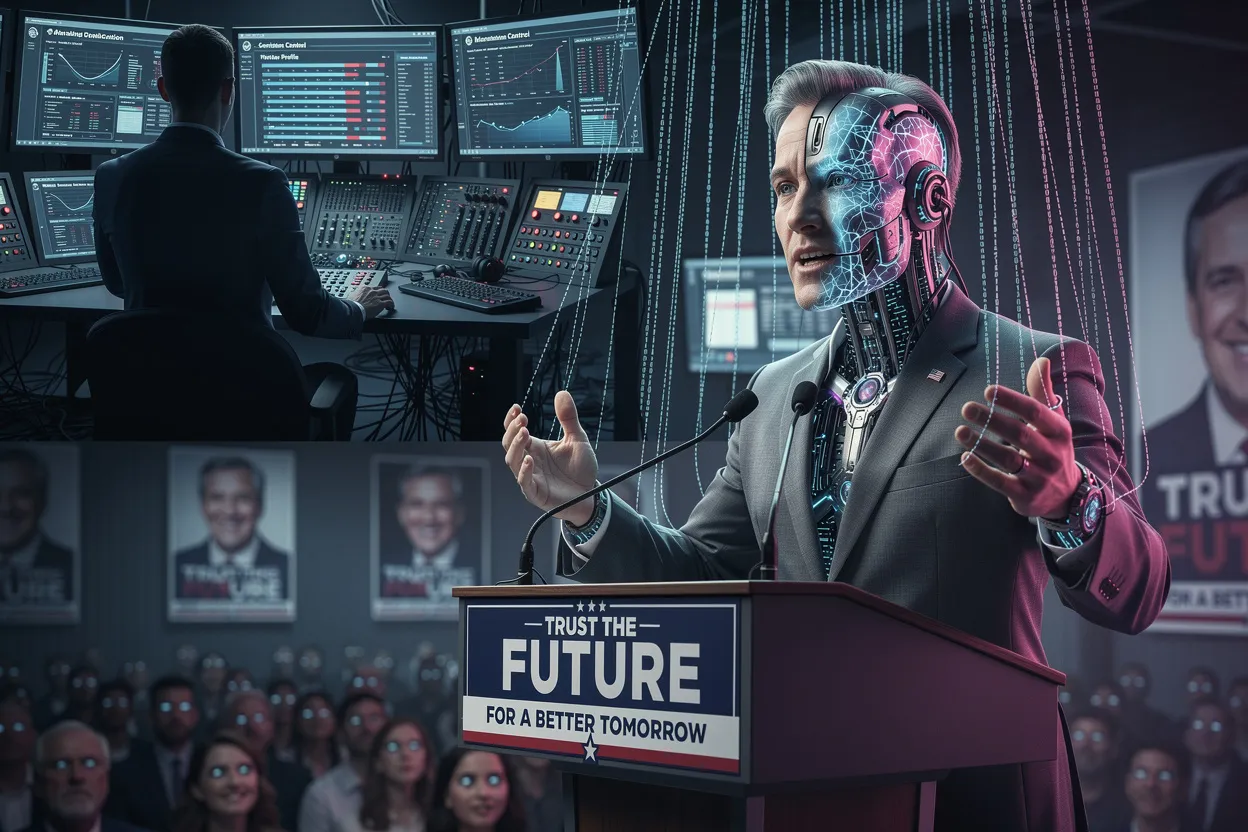
“This is the first AI-augmented campaign.” The phrase comes from Paul Brounais, founder of Electoral Lab, a political communications agency supporting candidates in 60 French cities. From metropolises to towns of just 250 residents, the municipal elections on March 15 and 22, 2026, are serving as a full-scale testbed.
ChatGPT writes flyers, chatbots answer voters’ questions at 2 a.m., and deepfakes of candidates circulate on WhatsApp. All this happens in an almost complete legal vacuum: the European AI Act, meant to regulate these practices, will only take effect in August 2026—five months after the election.
Is this a coincidence or a deliberate blind spot? Here’s what’s actually happening on the campaign trail.
What Parties Are Really Doing With AI
Content Creation Machines in Overdrive
At Renaissance, local teams use GPT-4 and Mistral to produce geo-targeted Facebook posts, replies to comments, and summaries of municipal council meetings to drop in mailboxes.
The Socialist Party (PS) has set up an internal workflow: after a public meeting, the candidate records a three-minute voice memo, which AI transcribes and rewrites into a flyer, a LinkedIn post, and an Instagram story—in under ten minutes.
Reconquête! is betting on video: Sarah Knafo, candidate in Paris, shares AI-generated video clips, ultra-fast in production and designed for the TikTok algorithm.
La France Insoumise is experimenting with automatic translation of flyers into Arabic, Turkish, and Tamil for working-class neighborhoods in Marseille and Saint-Denis.
Antoine Marie, political science and psychology researcher at Sciences Po Paris, sums it up in a phrase that’s making the rounds in newsrooms:
AI is a permanent intern. It doesn’t sleep, doesn’t complain, and delivers 80% of a decent job in 5% of the time.
The result? Volunteers who used to spend ten hours a week writing and laying out flyers now spend just three hours on the same tasks.
The time saved is now dedicated to door-to-door outreach which, ironically, boosts human contact instead of replacing it.
Campaign Chatbots Operating 24/7
In Toulouse, an independent right-wing candidate added a chatbot to his campaign website. Residents ask about parking, school lunches, zoning regulations.
The bot answers using the candidate’s platform, uploaded to its knowledge base. In Chantilly, a similar setup runs via WhatsApp: 1,200 conversations in two weeks, according to the campaign team. The cost? Less than 150 euros a month for OpenAI’s API.
Hyper-Local Targeting: From Neighborhoods to Buildings
The real breakthrough is geo-microtargeting. By combining open INSEE demographic data, field intel from volunteers, and Google search trends by postal code, campaign teams are segmenting their messages neighborhood by neighborhood—sometimes even street by street.
A flyer for a suburban housing development talks about property taxes; in the priority neighborhood, it’s about a new bus shuttle or local health center.
No need for a data scientist: tools like Claude or ChatGPT can analyze a CSV file in thirty seconds and generate three message variants tailored to each segment.
Cognitive, not financial, asymmetry: AI doesn’t give the advantage to the richest—it benefits the fastest and most organized.
A grassroots slate of five people, if well-equipped, can produce as much campaign content as a poorly coordinated regional federation with 200 activists.
This is a real democratization of campaign resources—with all the risks that entails.
Deepfakes & Misinformation: The Real Threat Level
Verified Cases on the French Campaign Trail
Let’s get concrete. In Grenoble, a deepfake audio of incumbent mayor Éric Piolle circulated on Telegram in mid-February 2026. In the 47-second clip, you reportedly hear him admit in private that “the low-emission zone is nonsense, but it appeals to the urban elite.”
The audio was shared over 8,000 times before Piolle’s team issued a denial. Viginum concluded it was a fake, created with free online voice cloning tools.
In Strasbourg, a fake video interview of the conservative (LR) candidate was posted on a site mimicking Dernières Nouvelles d’Alsace.
The site, registered three weeks earlier with an offshore host, was part of a network of over 80 fake French-language news sites identified by Reporters Without Borders.
RSF attributes this network to the Russian group Storm-1516, which has been active for five months leading up to the election.
In Guéret, the incumbent mayor took a contrary approach: he refuses to use AI, writes his speeches by hand, and makes it a campaign talking point.
“I want people to know it’s me talking to them—not a machine,” he explains. His “anti-AI” stance has earned him unexpected local media coverage.
The Numbers Are Rising
In 2020, France’s data protection authority (CNIL) received 3,948 complaints related to municipal campaigns (unsolicited outreach, illegal databases, spam texts).
For 2026, internal estimates predict a much higher volume, driven by AI-generated content and complaints about digital identity theft.
The core issue is no longer indiscriminate email collection—it’s industrial-scale fakery for the cost of a Netflix subscription.
The Institutional Response: Reinforced Viginum and “Algorithmic Reserve”
Viginum, the service for vigilance and protection against foreign digital interference, has released an operational guide for campaign teams.
Its workforce has increased by 40% since 2024, with a division dedicated to the municipal elections. The agency monitors social media in real time for spikes in suspicious content and alerts local authorities.
A new idea is circulating in government circles: the “algorithmic reserve”, a pool of AI experts that could be mobilized during election periods, similar to the Defense Citizen Reserve. The concept sounds attractive on paper.
But in practice, before March 2026? No one really believes it will be implemented in time.
RSF warns: the 80+ fake French news sites linked to Storm-1516 aim to “exacerbate social divisions” and specifically target local elections—seen as less closely monitored than the presidential contest.
The AI Act Comes Into Play—But Too Late
A “High Risk” Label for Electoral AI Systems
The European AI Regulation (AI Act) explicitly classifies AI systems used in electoral contexts as “high risk.”
In practice, this means any AI tool intended to influence an election—ad targeting, voter profiling, automated campaign content creation—should be subject to a compliance review, technical documentation, and a transparency requirement for citizens.
On paper, it’s solid. The issue boils down to a date: August 2026. The high-risk system requirements won’t be fully enforceable until after the March elections.
Candidates using AI in this campaign are operating in a world where the AI Act exists in theory, but lacks real teeth—at least for now.
Accident of Timing or Feature?
The question deserves to be addressed head-on. Those in power at the time of the regulation’s negotiation in Brussels were well aware of the French election calendar.
The gap between the regulation’s adoption (2024) and its election-related provisions taking effect (August 2026) creates a five-month window during which the municipalities will be contested with no AI Act constraints.
Coincidence? Maybe. But the effect is the same: political parties are free to experiment.
What the CNIL Is Doing During the Campaign
The CNIL hasn’t stood still. It launched an AI in Elections Observatory and published updated guidelines for candidates: you can’t use personal data for AI-targeted messaging without consent; you must disclose any AI use in campaign communications (currently on the basis of GDPR, not the AI Act).
But sanctions are limited: during elections, the wheels of justice don’t turn at the same speed as politics. A CNIL warning arrives after the runoff, while the deepfake flyer has already done its work.
The legal vacuum at a glance: The AI Act labels electoral uses of AI as “high risk,” but its rules will only apply from August 2026—five months after the municipal elections.
Only the GDPR and CNIL recommendations regulate this campaign. Sanctions always come after the vote.
What Does This Mean for Citizens?
Five Warning Signs of Suspicious AI-Generated Content
Received a flyer, video, or audio from a candidate that seems off? Here’s what to look for:
- The voice sounds “too clean”: no background noise, no hesitation, no natural breathing. AI voice clones produce smoothed-out, almost radio-quality sound.
- The news site is unfamiliar: check the domain name. A fake “DNA” or “La Montagne” site may have a subtly different URL (an extra dash, a .info instead of .fr).
- The text is too perfect: a flyer without so much as a clumsy phrase—featuring language a local politician would never use—could be AI-generated.
- The candidate’s image has artifacts: distorted hands, weirdly blurry backgrounds, asymmetric ears. Image generators are improving fast, but details can still give them away.
- The content plays on raw emotion: anger, outrage, fear. Disinformation campaigns maximize shares by provoking visceral reactions.
Where to Report and Fact-Check
Three reliable and free resources:
- Viginum – the government service accepts online reports of suspicious content linked to foreign influence campaigns.
- AFP Factuel – the French news agency’s fact-checking service investigates viral content and publishes results for public access.
- ARCOM (formerly CSA) – the national audiovisual regulator offers a reporting platform for problematic election content shared online.
An informed citizen remains the best firewall against election disinformation. No detection algorithm will replace the healthy reflex to check a source before sharing.
After the Election? “AI-Augmented Town Halls”
One point the press seldom mentions: some candidates are already speaking openly about AI-assisted local governance as part of their post-election plans.
Municipal chatbots for administrative tasks, automatic summaries of council meetings, predictive analysis of local needs in daycares or transportation. The government is also promoting “Albert,” a sovereign AI solution built for public services.
AI won’t disappear the night the runoff ends. It will move into town halls—and that’s another conversation citizens will need to have with their elected leaders.
An augmented democracy can work—if citizens know what’s influencing them, who is really speaking, and what machine is behind the message.
The 2026 municipal elections are the first real test. What’s at stake here isn’t just about the 35,000 municipalities.
This is the dress rehearsal for the 2027 presidential election.
FAQ
Which parties are actually using AI for the 2026 municipal elections?
Renaissance, the Socialist Party (PS), Reconquête!, La France Insoumise, and the National Rally (RN) all use generative AI tools to varying degrees. Uses range from automatic flyer writing to viral video creation and multilingual translations of campaign material.
Have candidate deepfakes really circulated in France?
Yes. A deepfake audio of Grenoble mayor Éric Piolle was shared over 8,000 times on Telegram in February 2026. In Strasbourg, a fake video interview with a conservative (LR) candidate appeared on a site mimicking a local newspaper. Viginum confirmed these were fraudulent.
Does the AI Act apply to the March 2026 municipal elections?
No—not for the high-risk system requirements. The regulation exists, but the election-specific provisions only take effect in August 2026, five months after the election. Only the GDPR covers AI use this campaign season.
What is the CNIL doing to oversee AI usage during the campaign?
The CNIL has launched an observatory for AI usage in election campaigns and published updated guidance. It processes citizen complaints and can issue formal warnings. The problem: sanctions typically come after the vote.
How can I report AI-generated election content I find suspicious?
There are three main channels: Viginum’s form for reporting foreign interference, AFP Factuel’s platform for fact-checking, and ARCOM’s site for problematic election content published online.
How much does an AI-powered campaign chatbot cost?
Campaign teams report spending around 100 to 200 euros a month for API calls to models like GPT-4 or Claude. Most of the cost is human: setting up the bot, uploading the campaign platform, supervising the interactions.
Does AI benefit big parties over small grassroots campaigns?
Not necessarily. AI creates cognitive, not financial, asymmetry. A small, well-organized team comfortable with these tools can produce as much as an entire regional federation. The edge goes to the fastest— not the richest.
What is the “algorithmic reserve” proposed by the government?
It’s a concept for a pool of AI experts who can be mobilized during election periods, inspired by the Defense Citizen Reserve. The idea is to boost the ability to detect manipulation. Whether it will be implemented in time for this election remains unclear.
What exactly are “AI-augmented town halls”?
Some candidates want to use AI post-election for municipal management: chatbots for administrative tasks, automatic council meeting summaries, predictive analysis of community needs. The government is promoting “Albert,” a sovereign AI dedicated to public services.
Are these municipals really a dress rehearsal for the 2027 presidential?
All signs say yes. Parties are testing tools, measuring results, and finding loopholes. Lessons learned in March 2026—about content production, deepfake detection, and the institutional response—will shape the 2027 campaigns.
Related Articles

Reddit blocks AI scraping: what it means for LLMs and open source
On March 25, 2026, Reddit sent shockwaves through the AI community: the platform is shutting its doors to automated scrapers, requiring biometric verification for suspicious accounts, and removing 100,000 bot…

Claude Mythos: what the Capybara leak reveals about Anthropic’s next model
On March 26, 2026, two cybersecurity researchers stumbled across something Anthropic never meant to show: roughly 3,000 internal assets exposed publicly on the company’s blog, including draft posts revealing the…