
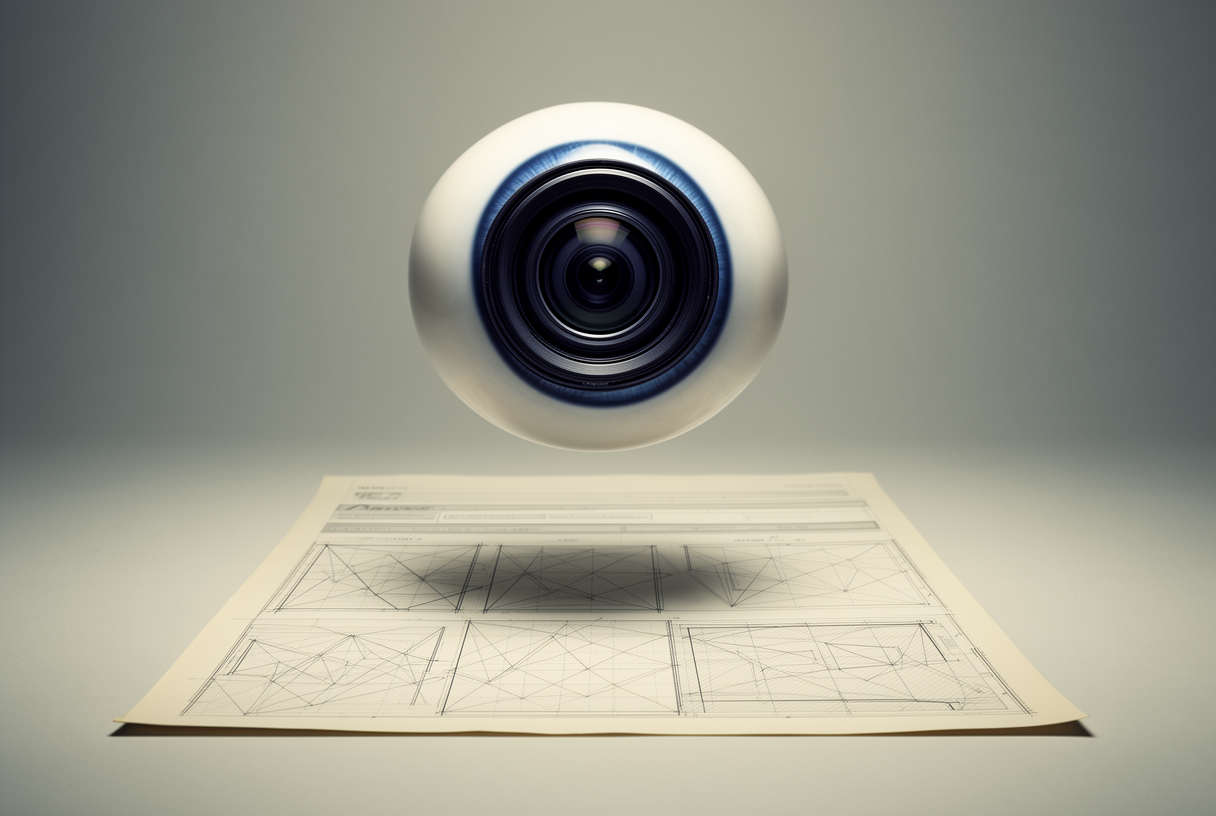
On April 16, 2026, Anthropic launched Claude Opus 4.7 design, a model with image resolution tripled and a SWE-bench Pro score jumping from 53.4% to 64.3% in just one version.
The key question arises immediately: will we still need a graphic designer or a front-end dev in 2026?
This article tackles the issue head-on, with three ROI scenarios in euros for a French SME, the map of rising or falling archetypes, and the areas where Opus 4.7 still fails and is costly.
The shift is due to a measurable change in the design margin, not a vague promise: commoditized tasks are compressed, while strategic advice remains premium.
In brief
- 3x vision, zero generation: Opus 4.7 reads up to 2576 pixels (3.75 MP) and reaches XBOW at 98.5%, but it has never generated an image and still doesn’t
- Front-end code shifts: SWE-bench Pro 64.3%, CursorBench 70%, OSWorld 78%, and landing pages and internal CRUD are done in review, not from scratch
- The Ramp study quantifies the shockwave: $1 of freelance spending replaced by 3 cents of AI spending, design work down 17%, development down 21%
- SME ROI is clear but not painless: eco-tech landing page €200 + risk €240 (vs €1500), dashboard redesign €1200 + risk €800 (vs €5000), branding €750 but high strategic risk
- Three archetypes survive in 2026: AI-Augmented Specialist (freelance Malt €80-150/h), System Architect (€50-70k/year), Irreplaceable Specialist Human (€45-80k/year)
What Claude Opus 4.7 sees (and doesn’t see) since April 16, 2026
Key figures: 3x vision, SWE-bench Pro 64.3%, XBOW 98.5%
Anthropic officially launched Claude Opus 4.7 on April 16, 2026, with a precise visual leap: the input image reaches 2576 pixels on the long edge, about 3.75 megapixels.
This is 3.3 times the resolution of Opus 4.6 (1.15 MP), which maxed out at 1568 pixels and required resizing every screenshot before sending.
Partner XBOW, specializing in autonomous pentesting, reports a jump in its visual acuity score from 54.5% to 98.5%.
On the CharXiv Reasoning bench, which assesses the reading of scientific figures, the score without tools rises from 69.1% to 82.1%.
In terms of code, SWE-bench Pro goes from 53.4% (Opus 4.6) to 64.3%, ahead of GPT-5.4 at 57.7% and Gemini 3.1 Pro at 54.2%.
On CursorBench, Cursor’s in-house bench, the score rises from 58% to 70%, with four tasks that no previous model could solve.
OSWorld-Verified (computer use) goes from 72.7% to 78%.
The price remains the same as Opus 4.6: $5 per million input tokens, $25 per million output tokens, within a context window of one million tokens.
What the model still doesn’t do
Opus 4.7 analyzes images, it doesn’t generate them.
This distinction, missed by most French articles published since April 16, underpins the entire reasoning.
Midjourney, Ideogram, Flux, Stable Diffusion remain the engines of visual generation; Opus 4.7 reads them, critiques them, breaks them down into tokens, not the other way around.
Opus 4.7 doesn’t feel the harmony of a palette, doesn’t judge a typographic hierarchy, doesn’t choose between two brand directions, it measures, compares, proposes a grid.
The model doesn’t replace complex animation, motion design, or field user research.
It still struggles on Terminal-Bench 2.0 (69.4%, behind GPT-5.4 at 75.1%), which concerns CLI agents and less so pure web front-end.
Cases where Opus 4.7 replaces billed work
Landing pages, internal dashboards, moodboards, coherent icon sets
The tasks that get compressed first are the most templatable.
A standard eco-tech landing page with a capture form, three benefit blocks, and a hero visual falls directly within Opus 4.7’s strike zone.
An internal SaaS back-office dashboard, with shadcn/Tailwind charts and data tables, comes out clean on the first try in over 70% of cases observed on CursorBench.
Moodboards aligned with a client reference, icon sets derived from an existing system, medium-fidelity wireframe mockups fall within the same scope.
Recent comparisons between Claude Code and AI developer assistants show that the agent layer changes production speed, not just the quality of the isolated snippet.
The Ramp study: 97% of freelance budget shifted to AI
Ryan Stevens, director of applied science at Ramp, published a paper titled “Payroll to Prompt” at the end of 2025, tracking the spending of 50,000 companies from Q3 2021 to Q3 2025.
Raw result: for every dollar removed from the Fiverr or Upwork budget by the most exposed companies, only 3 cents are redeployed to AI subscriptions.
Freelance spending on marketplaces dropped from 0.66% to 0.14% of total spend; AI model provider spending rose from 0 to 2.85% over the same period.
Marketplace graphic design fell by 17%, freelance software development by 21%.
A Fiverr freelancer who charged $150 for a series of social posts sees their orders absorbed by a Midjourney subscription at $10 a month plus a short human review.
This shift aligns with the latest Ramp Spring 2026 data: 50.4% of US companies now pay for at least one AI service, with Anthropic accounting for 30.6% of the paid market versus 35.2% for OpenAI.

Where Opus 4.7 still fails (and costs when unnoticed)
Visual hallucinations, WCAG accessibility, broken mobile responsiveness
The benchmarks hide well-documented production gaps.
User tests published since April 17 report a 10 to 15% visual hallucination rate on complex mockup interpretation: invented components, incorrect margins, inferred hover states.
On accessibility, no generalist model passes a full WCAG 2.2 AA audit without a dedicated pass: out-of-threshold contrasts, broken tab orders, missing ARIA labels regularly emerge from its front-end renders.
Mobile responsiveness is another black spot: a generated component broken below 375 pixels wide remains the norm without explicit instruction in the prompt.
The hidden cost of Opus 4.7 lies in one formula: the review time by a qualified human dictates the real ROI, not the token price displayed by Anthropic.
An SME shipping without WCAG pass and without responsive QA incurs the legal risk on accessibility and the bounce rate risk on conversion.
Existing design systems and multi-asset brand coherence
Without a structured Design System input (color tokens, typographic variables, spacing scales), Opus 4.7 creates a generic system that doesn’t align with the brand.
The feedback published by Sfeir in April 2026 is clear: the quality of the Figma file organization determines the quality of the AI output, not the other way around.
On multi-asset branding (logo, site, deck, social templates, print), brand coherence is lost as soon as you move from three to seven parallel deliverables.
Verbal identities, iconographic poise, signature rules remain outside the model’s scope.
ROI calculation for a French SME: three quantified scenarios
Eco-tech landing, SaaS dashboard redesign, complete branding
Consider a typical French SME, 20 employees, €3 million turnover, based in Lyon.
The first scenario is an eco-tech landing page in French for a product range: a senior Malt freelancer historically charged €1500 for three days of work.
The new gross cost drops to €200 (10 hours of internal review at €20/h on a Claude Opus 4.7 output connected to v0 or Figma Make), increased by a redo risk of €240 (30% probability, cost €800).
Net adjusted savings: €1060.
Second scenario, a redesign of an internal SaaS dashboard: a contractor charged €5000 for five days of work, the new cost drops to €1200 (20 hours review plus two days dev integration) plus a risk of €800 (responsive and accessibility bugs).
Net savings: €3000, but with a requirement for code review by an experienced front-end dev.
Third scenario, a complete branding (logo, guidelines, deck, showcase site): the studio contractor charged €3500, AI drops it to €750 visible but the strategic risk is high: a failed identity costs a repositioning two years later, i.e., €8000 to €15,000 in real hidden cost.
The quantified verdict: profitable shift on landing page and dashboard, strong caution on strategic branding.
Who wins, who loses: the design and front-end market map

Three archetypes surviving in 2026
The market splits into three distinct profiles since the first quarter of 2026.
The first, AI-Augmented Specialist, is a freelancer delivering ten landing pages a month compared to just one before: they charge between €80 and €150/h on Malt, reduce their production hours by 85%, and reinvest the time saved in client strategy.
The second, System Architect, designs and maintains corporate design systems that AIs consume as input, with an APEC salary observed in Q1 2026 between €50,000 and €70,000 gross annually.
The third, Specialist Human, holds the line on what’s irreplaceable: strategic art direction, foundational brand identities, advanced WCAG accessibility, complex motion design, with an APEC range of €45,000 to €80,000 annually.
In the US, the new role of AI Art Director is emerging explicitly, with announced ranges between $121,000 and $210,000 on OnwardSearch for Q1 2026.
Malt/APEC 2026 ranges and roles that are declining
The clear losers are identifiable: the junior CSS/HTML executor billing by the hour on templates, the social media graphic designer producing five visuals a day without editorial angle, the front-end developer specializing in pixel-perfect Photoshop-to-HTML integration.
A secondary signal comes from the Stack Overflow Developer Survey 2026: 84% of developers use AI daily, but confidence in its results has dropped from 40% in 2024 to 29% in 2025.
Mass adoption doesn’t mean enthusiasm: experienced devs adopt the tool without trusting it, which reinforces the value of the senior critic role, not the junior producer.
A historical parallel sheds light on this restructuring: the DTP of the 1990s didn’t kill graphic designers, it killed typographers who composed in lead.
Opus 4.7 kills the template-executing graphic designer, it doesn’t touch the art director who holds the editorial angle.
The honest answer: should you still hire a graphic designer or front-end dev in 2026?
The answer is summed up in three short, decisive sentences.
Yes for the strategic profile (art director, design system owner, senior product designer): no 2026 model replaces the editorial judgment, brand decision, product arbitration.
No for the pure executor profile (junior templater, pixel-perfect integrator, social media graphic designer without angle): the margin is already compressed, the trajectory points to zero in eighteen months.
Hybrid for the intermediate technical profile (mid-level front-end dev, UI designer with components): recruit with an explicit clause for daily Opus 4.7 or equivalent use, pay based on the quality of the final output, not production hours.
For the SME hesitating between a freelancer at €400/day and a Claude subscription at €20 per month for chat use and around €300 to €800 per month for intensive API use, the right question is no longer the cost, it’s the level of internal review available at the client.
Without a qualified reviewer on the SME side, the apparent saving becomes a hidden cost.
With a qualified reviewer, the shift is already profitable on 70% of tasks.
Claude Opus 4.7 and design in 2026 FAQ
Should I fire my freelance graphic designer now to switch to Claude Opus 4.7?
No, but reorganize their scope: reserve them for art direction and brand coherence, entrust landing pages and icon sets to an Opus 4.7 workflow.
Does Claude Opus 4.7 compete with Figma or Adobe for true UI/UX design?
Not directly: Opus 4.7 reads and generates code, Figma remains the collaborative editing surface, and Adobe holds the print and motion market.
Claude Design, launched by Anthropic the same day, is starting to tackle the prompt-to-prototype layer that Figma Make occupied alone.
Will I fall behind if my competitors use Opus 4.7 and I don’t?
Yes on commoditized tasks, no on strategic tasks, as the competitive risk is on the speed of landing page delivery, not brand identity.
Does Opus 4.7 read a Figma mockup and generate code that works on the first try?
Yes for standard React-Tailwind cases, with a 70% success rate on CursorBench measured by Cursor.
No for advanced custom components or complex animations that require systematic human review.
Are visuals generated via the Opus 4.7 plus Midjourney workflow legally safe for commercial use?
The copyright risk remains open on Midjourney outputs trained on unlicensed data; French jurisprudence Q1 2026 hasn’t definitively ruled.
The standard workaround is a shared liability clause in the contractor agreement or a Midjourney Pro subscription with indemnification.
How much does a Claude Opus 4.7 workflow really cost to deliver what a freelancer at €400/day delivers today?
Between €200 and €1500 per deliverable depending on complexity, with 30 to 60% hidden cost in qualified internal review.
Which designer and front-end dev profiles see their value rise in 2026?
System Architects who manage design systems, AI Art Directors who orchestrate brand prompts, Specialist Humans who maintain accessibility and complex motion.
Which tasks should remain outside AI scope in 2026?
Strategic branding, full WCAG 2.2 AA audit, micro-interactions with high emotional charge, field user research.
Should we stop training juniors in design and front-end if Opus 4.7 does the work?
No, but train differently: juniors in 2026 learn AI output review, design-oriented prompt engineering, critical code reading before pure CSS execution.
Does Claude Design replace Figma for an SME in 2026?
Not yet in April 2026, Anthropic’s product is in preview and Figma holds 80 to 90% of the UI/UX market according to AI-Stat estimates; active monitoring recommended for SMEs over the next six months.
Related Articles

Agentik vs Monid: comparing AI agent tools
Connecting an AI agent to the real web quickly becomes like juggling a bunch of keys. A web search here, a scraping tool there, a contact enrichment service, an image…
What is Jev? The AI model that doesn’t generate text
Jev IA, lancé par TypeSafe le 15 septembre 2026, classe et note au lieu d’écrire. Fonctionnement, prix, limites et ce que cela change pour votre logiciel.