
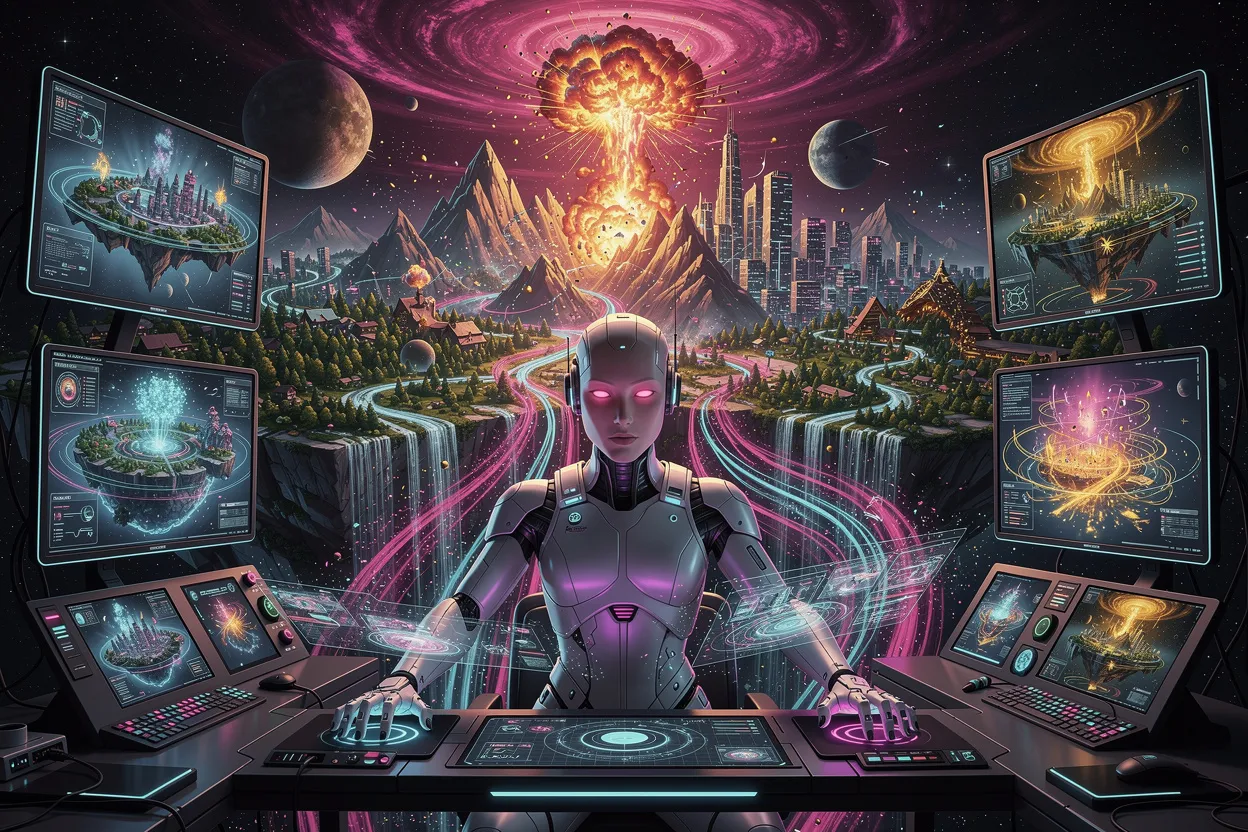
Google DeepMind has just made a major breakthrough with Genie 3, its new generative world model. Forget about passive AI-generated videos—here, we’re talking about interactive 3D worlds created in real time, where you can move around, alter the environment, and observe consistent physics.
For robotics, this is a small revolution that opens up large-scale training possibilities previously thought impossible.
What Is a World Model and Why Genie 3 Changes Everything
A world model is an AI system capable of understanding and simulating the rules of an environment—not just generating pretty pictures or videos, but predicting what happens when you interact with that world. Genie 3 doesn’t create passive content; it builds explorable universes, frame by frame.
Its functioning relies on auto-regressive generation. In practice, the model creates each frame based on the previous one and the user’s actions.
Move forward? It generates what appears ahead of you. Turn left? It calculates the new perspective in real time. The result: 24 frames per second in 720p HD, with physical consistency maintained for several minutes.
What sets Genie 3 apart from video generators like OpenAI’s Sora or Google’s Veo is this interactivity. Those tools create predefined linear sequences. Genie 3 reacts to your actions and adapts the environment accordingly.
Key point: Genie 3 maintains a visual memory of about 1 minute. If an object disappears from your field of view and then reappears, the system remembers it and restores it correctly. This persistence is crucial for credible simulations.
Interactive 3D Environments From a Single Image
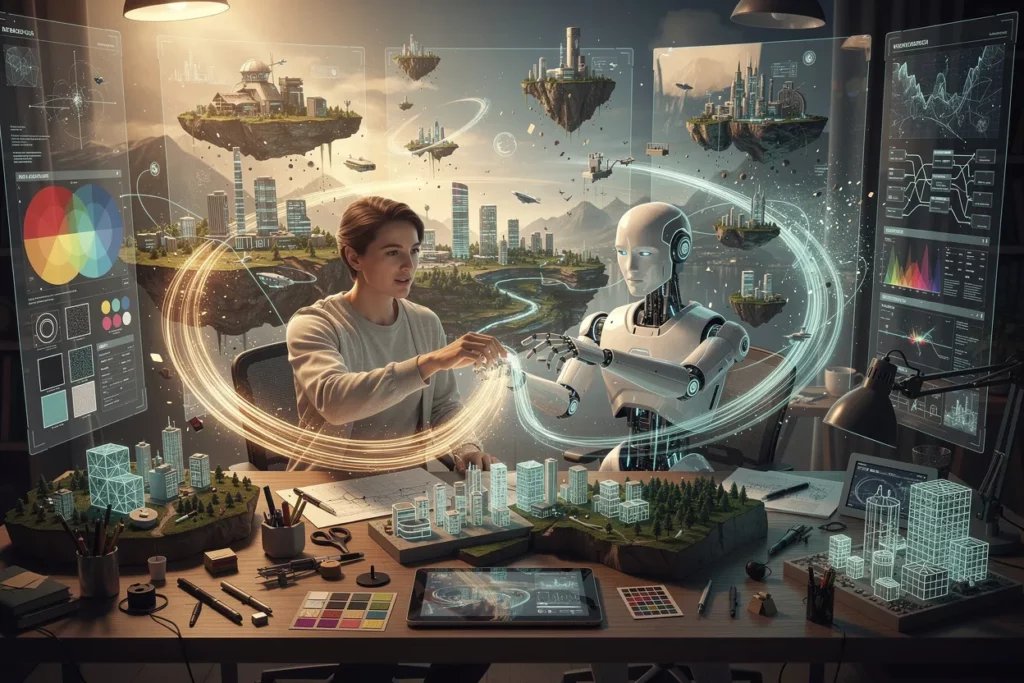
Genie 3’s technical promise can be summed up in a single sentence: give it an image or a text description, and it generates an explorable world. Want to walk through a tropical rainforest? Just describe it. Have a photo of an industrial warehouse? Genie 3 turns it into a navigable space.
Advanced Physical Simulation
The model doesn’t just create static backgrounds. It simulates complex physical phenomena:
- Fluids and particles: flowing lava, ocean waves, dispersing smoke
- Atmospheric effects: lighting variations, weather conditions adjustable via prompt
- Dynamic behaviors: vegetation that reacts, animals with consistent movements
- Physical interactions: realistically simulated gravity, collisions, and friction
A striking example: you can ask Genie 3 to simulate a robot crossing volcanic terrain. The system models the flowing lava, ascending smoke, and keeps a coherent egocentric perspective throughout the journey.
Real-Time Editing Via Prompts
Genie 3’s “foundation” nature is revealed in its flexibility. During exploration, you can alter the environment with natural language instructions. Change the weather from sunny to rainy, add obstacles, transform the lighting. The world adapts without breaking continuity.
Foundation World Model: A Base for a Thousand Applications
Google DeepMind presents Genie 3 as a “foundation world model”. This terminology is significant.
Just as foundation language models like GPT or Gemini serve as the basis for a variety of applications, Genie 3 aims to become the core platform for creating simulated environments across all fields.
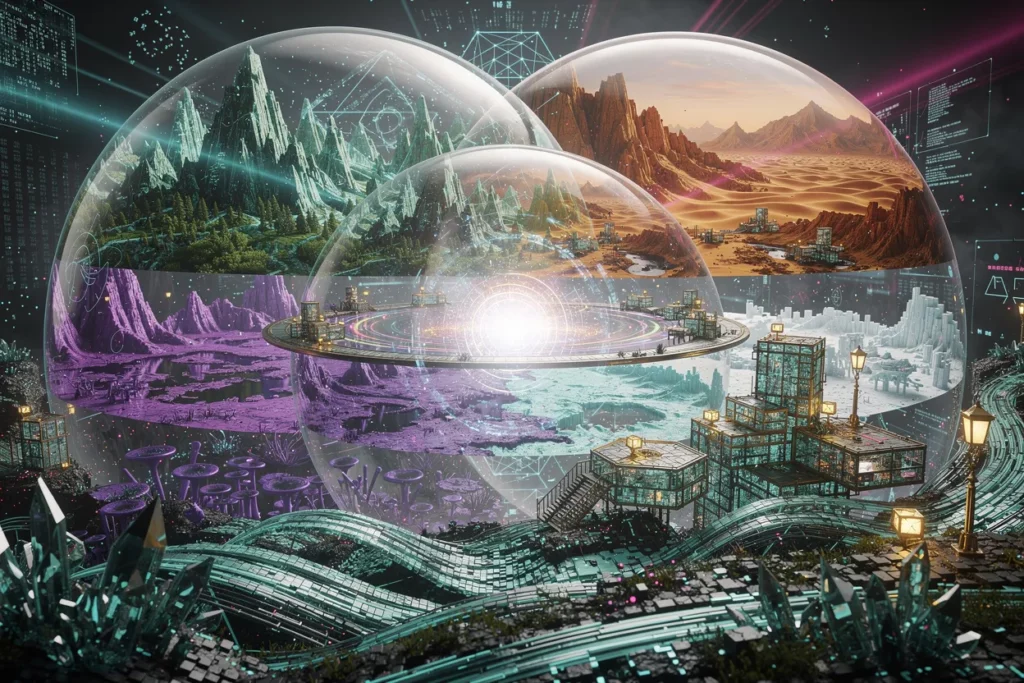
This approach changes the philosophy of AI development. Instead of building specialized simulations for each use case (one simulator for cars, another for drones, a third for object manipulation), a single generative model can produce all these environments. All you have to do is describe what you need.
For AI research teams, this is a huge time saver. No more need to develop dedicated physics engines or manually model every scenario.
Real-World Applications in Robotics
It’s probably in the field of robotics that Genie 3 will have the most immediate impact. Training robots presents a well-known challenge: real-world tests are expensive, time-consuming, and can damage hardware.
Simulation offers an alternative, but traditional simulators require significant modeling work.
Training Autonomous Agents
Google DeepMind is already using Genie 3 to train SIMA, its AI agent designed to complete complex tasks in diverse environments.
The principle: generate thousands of different scenarios, let the agent evolve in these simulated worlds, observe its performance, and address its weaknesses.
This approach creates what researchers call an “infinite curriculum”. The agent never trains twice in exactly the same environment. As a result, it develops a generalization capacity impossible to achieve with static datasets.
Genie Sim 3.0: The Simulation Platform
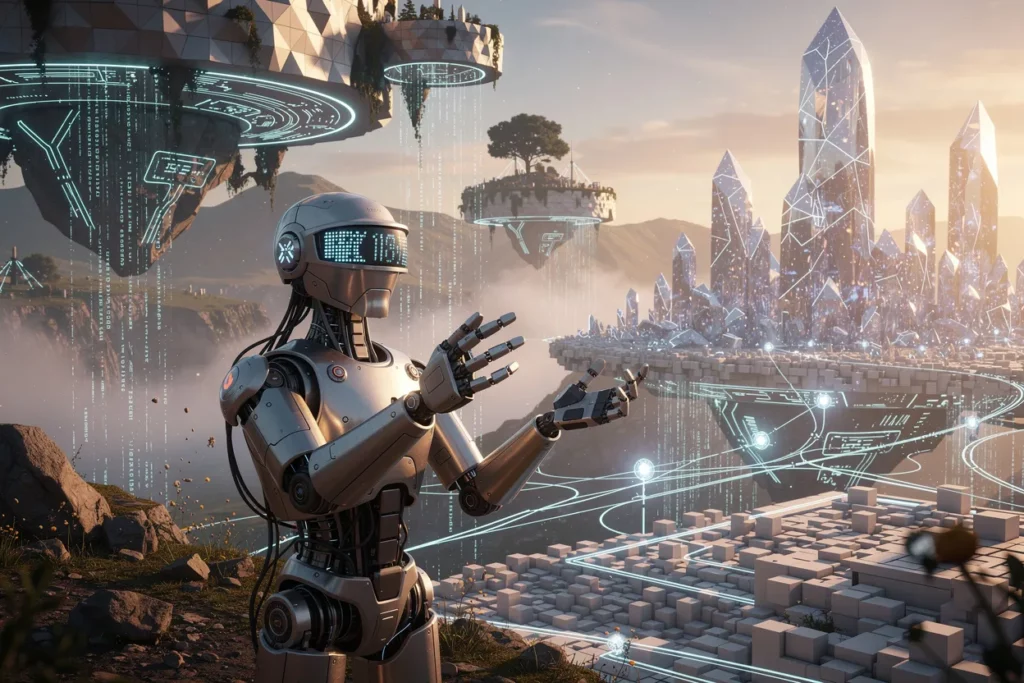
Genie Sim 3.0 harnesses Genie 3’s capabilities for applied robotics. The platform generates high-fidelity scenes from natural language instructions.
A concrete example: generating thousands of warehouse configurations to train logistics management robots, with variations in lighting, shelf layout, and types of objects to handle.
- Massive data generation: thousands of scenarios automatically created
- Multi-dimensional variation: lighting, layout, sensor noise adjustable via prompt
- Realistic physics: collisions and friction calibrated for transfer to the real world
Sim-to-Real Transfer
The key challenge of robotics simulation remains sim-to-real transfer. A robot that performs well in simulation can fail miserably in the real world if the conditions are too different.
Genie 3 addresses this issue thanks to the quality of its physical simulation and the diversity of generated environments.
The synthetic datasets produced by Genie Sim 3.0 have been validated for zero-shot transfer to reality. A robot trained exclusively in simulation can operate directly in a physical environment without any additional adaptation phase.
Key takeaway: Successful sim-to-real transfer represents the Holy Grail of modern robotics. If Genie 3 lives up to its promise, it could dramatically reduce the cost and time required to develop robotic systems.
From Genie 1 to Genie 3: The Rapid Evolution
Genie 3 didn’t just come from nowhere. Google DeepMind has advanced through successive iterations.
Genie 1, introduced in 2024, showed the concept was feasible: generating interactive 2D environments similar to video games. The capabilities were limited, but the idea was proven.
Genie 2 took a leap forward by moving to 3D and improving temporal consistency. The model could maintain a stable environment for a few seconds of interaction.
With Genie 3, we’re at another level: consistency, HD resolution, detailed physical simulation. The gap between versions highlights how rapidly the world model domain is evolving. What seemed out of reach 18 months ago is now operational.
To understand this acceleration in the wider context of AI, AI trends for 2025 show that world models are now a top research priority for major labs.
Implications for Generative AI and Reinforcement Learning
Genie 3 sits at the intersection of two domains that have until now been mostly separate: generative AI (content creation) and reinforcement learning (training agents via trial and error).
Traditional generative models produce static outputs: text, images, videos. Reinforcement learning requires interactive environments where the agent can act and get feedback. Genie 3 bridges this gap by dynamically generating training environments.
This convergence opens new horizons for research toward artificial general intelligence. A system capable of accurately modeling the real world is an essential building block for more versatile AIs.
Beyond Video Games and Robotics
The potential applications go far beyond the initial use cases:
- Educational simulations: interactive historical or scientific recreations
- Game prototyping: test gameplay mechanics without full development
- Counterfactual research: explore “what if” scenarios in simulated environments
- Scientific visualization: represent complex phenomena interactively
Current Limitations and Outlook
Genie 3 is impressive, but has limits that shouldn’t be overlooked. Its coherence duration is still restricted to a few minutes. For now, it’s impossible to maintain a stable world for hours of exploration. For long robotic simulations, sessions have to be split.
Geographical accuracy is lacking when it comes to real locations. Asking for a faithful reconstruction of an existing city will give you an approximate result. Legible text in generated environments has to be explicitly specified in the prompt.
The 720p resolution enables real-time interactivity but falls short of current video standards. Competitors like Veo offer up to 4K, but without interactivity.
As for access, Genie 3 is still in research preview at DeepMind. Public APIs and SDKs are expected, but there’s no precise timeline yet. External teams will have to wait before integrating this technology into their projects.
FAQ
What’s the main difference between Genie 3 and video generators like Sora?
Sora generates passive videos where viewers have no control. Genie 3 creates interactive environments where users can move and change the world in real time. It’s the difference between watching a movie and playing a video game.
Can Genie 3 create any type of environment?
The model is highly versatile and can generate natural, urban, industrial, or fantasy settings. Real-world places won’t be reproduced with perfect geographical accuracy, but the style and vibe will be coherent.
How does Genie 3’s visual memory work?
The system retains a memory of visual elements for about 1 minute. If you leave an area and return, the objects will still be present and properly positioned. This persistence fades beyond that timeframe.
What are the hardware requirements to run Genie 3?
Google DeepMind hasn’t shared exact specs. The model runs on their cloud infrastructure. API access will let users leverage these capabilities without specific hardware, but local deployment will likely require significant GPU resources.
Does sim-to-real transfer work for all types of robots?
Validation has been done for manipulation and navigation tasks. For highly specialized applications like robotic surgery or drones in extreme conditions, further testing would be needed to guarantee transfer success.
Can you change the environment during exploration?
Yes, this is one of the key features. Using natural language prompts, you can change the weather, add or remove objects, or modify lighting. The world adapts without interruption.
Is Genie 3 accessible to the general public?
Not yet. The system is currently in research preview. Google DeepMind plans to offer APIs and SDKs for developers, but no release date has been announced. Prototypes like Project Genie let some users test certain features.
What is Genie 3’s resolution and framerate?
The model generates 720p HD images at 24 frames per second. This provides a smooth, interactive experience, but remains below premium video standards like 4K.
How does Genie 3 handle object physics?
The system simulates gravity, collisions, friction, and object interactions. It can model complex phenomena like fluids, smoke, or particles. The simulation is precise enough for robotic training with real-world transferability.
What future developments can we expect for Genie?
Google DeepMind is likely working on extending the coherence duration, increasing resolution, and enhancing physical fidelity. Integration with other Google tools like Gemini for more natural control is one logical evolution.
Related Articles

Reddit blocks AI scraping: what it means for LLMs and open source
On March 25, 2026, Reddit sent shockwaves through the AI community: the platform is shutting its doors to automated scrapers, requiring biometric verification for suspicious accounts, and removing 100,000 bot…
Claude Mythos: what the Capybara leak reveals about Anthropic’s next model
On March 26, 2026, two cybersecurity researchers stumbled across something Anthropic never meant to show: roughly 3,000 internal assets exposed publicly on the company’s blog, including draft posts revealing the…