
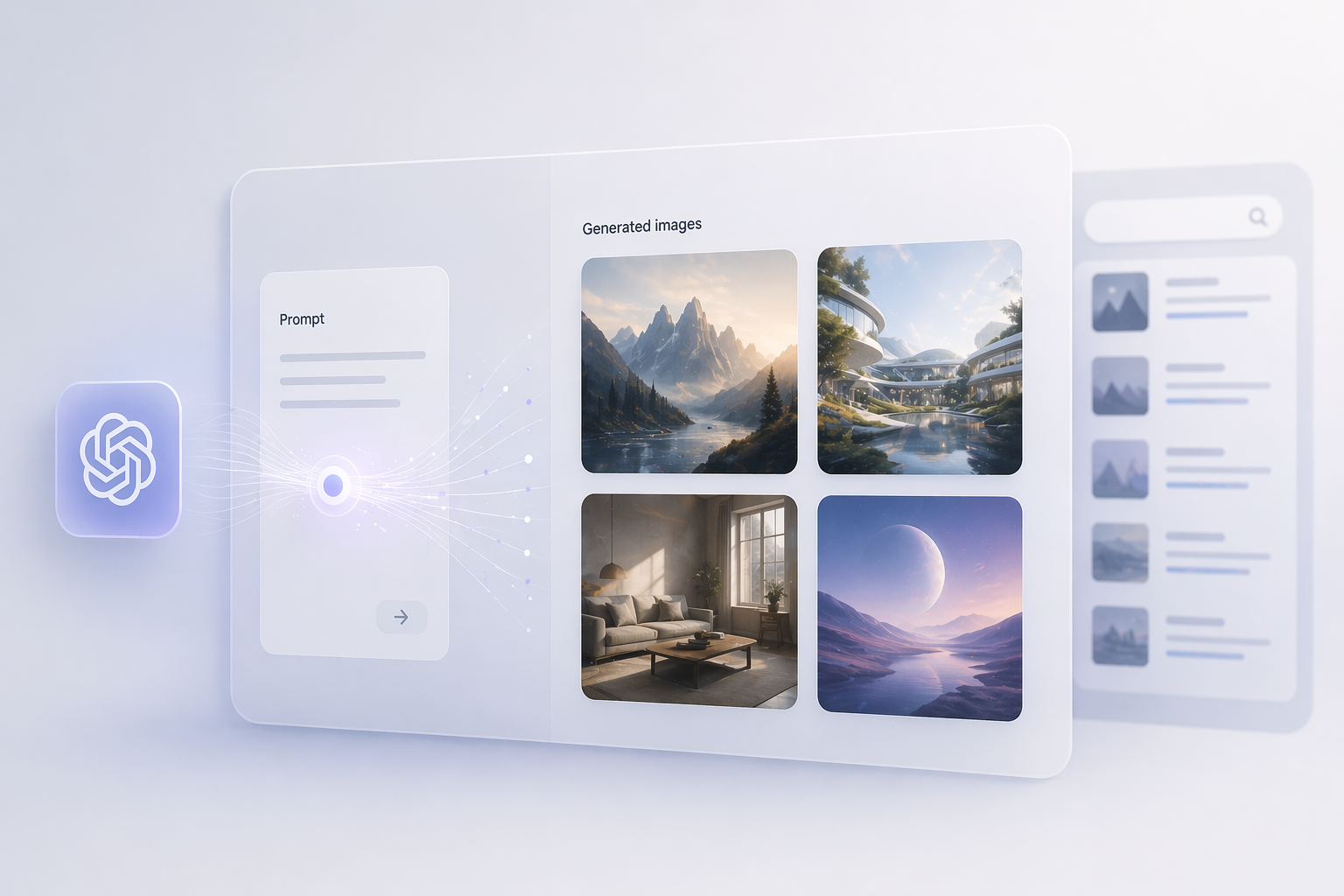
On April 21, 2026, OpenAI released GPT Image 2, a new image generation stack accessible via the gpt-image-2 API.
The release comes six weeks after Google’s Nano Banana 2, marking a direct response to the February breakthrough on LM Arena.
Initial independent measurements place GPT Image 2 at 99% accuracy for Latin text rendering, in native 4K, under three seconds per image.
The model breaks a rule set in March 2025 with GPT-4o: image generation is once again a dedicated stack, separate from the unified multimodal pipeline.
In brief
- Independent stack: GPT Image 2 leaves the unified GPT-4o pipeline for a dedicated single-pass image model
- API pricing: $8 per million input tokens, $30 per million output, estimated $0.15 to $0.20 per image
- 99% Latin text, CJK and Arabic playable, multilingual ceiling finally lifted
- Native 4K under 3 seconds per image, external upscaler out of chain
- Google retains speed and price advantage: Nano Banana 2 at $0.045-$0.151 per image, integrated with Search, Gemini, Vertex, and Ads
- FLUX.2 and Nano Banana Pro maintain the lead on 10 to 14 combinable images
What was announced on April 21, 2026
OpenAI unveiled GPT Image 2 during a presentation broadcast on April 21, 2026, six weeks after Google’s Nano Banana 2 release.
The model is immediately available in ChatGPT for paying users and via the gpt-image-2 API for developers.
The specifications confirm what LM Arena testers observed under the codenames maskingtape, gaffertape, and packingtape: three quality tiers, native 4K, hardened text rendering.
The step forward is less about having a new model and more about having a model usable in production without needing typographic retouching.
4K resolution, ratios 3:1 to 1:3, three tiers: Instant, Thinking, and Pro
The visible break with GPT Image 1.5 lies in the native resolution, which jumps from 1536 by 1024 to 4096 by 4096 pixels.
The ratios now range from panoramic 3:1 to vertical 1:3, with 16:9 and 9:16 support from launch.
Three quality tiers are presented: Instant under three seconds, Thinking for multi-object compositions, Pro for final commercial deliverables.
API gpt-image-2: endpoint, official pricing, availability
The gpt-image-2 endpoint coexists with gpt-image-1 and gpt-image-1-mini in the same token pricing grid.
The pricing for image tokens is $8 per million input, $2 for cached input, $30 per million output.
The estimated raw cost per standard image is around $0.15 to $0.20, a continuation with GPT Image 1.5 rather than a decrease.
Why OpenAI is moving away from the unified multimodal pipeline of GPT-4o
The architectural choice of GPT Image 2 contradicts the doctrine presented by OpenAI in March 2025.
At the time, GPT-4o image generation was presented as the victory of the unified multimodal pipeline: a single autoregressive transformer predicted text and image tokens, with shared memory.
Thirteen months later, the opposite direction is taken, returning to a dedicated image stack.
The limit of all-autoregressive for visual generation
Unification hits a ceiling as soon as visual quality reaches the level of Nano Banana Pro or FLUX.1.
The tensions are measurable: variable bit-rate between modalities, non-adaptive computation, trade-off between language precision and pixel precision.
A kitchen that runs fish, meat, and pastries on the same plate hits a ceiling in volume and quality as soon as the standard of each station rises.
OpenAI’s image lineage, from DALL-E 2 to DALL-E 3 and then to GPT Image 1, already told this tension between dedicated diffusion and chat integration.
Single-pass vs two-step: what the new architecture changes
The shift moves from a two-step pipeline to a single-pass inference.
In GPT Image 1.5, generation chained autoregressive planning followed by separate rendering.
The gain is measured in three axes: latency reduced from 8-12 seconds to under 3 seconds, native 4K output without upscaler, text integrated from the first pass.
Text rendering, the leap that makes GPT Image 2 production-ready
Text rendering in AI images has long been the Achilles’ heel of the segment.
Until GPT Image 1.5, text appeared like a sticky note on the scene, with invented letters and irregular spacing.
With GPT Image 2, text integrates into the rendering like ink on paper.
From 90-95% to 99% in Latin, the glass ceiling falls
Independent tests on LM Arena, reported by Simon Willison, TechCrunch, and the Hugging Face community, place Latin text accuracy around 99% on GPT Image 2, compared to 90 to 95% for GPT Image 1.5.
The gain seems marginal, but it has massive operational consequences.
The margin of error falls below the threshold where humans need to retouch each rendering, and a screen with fourteen UI labels, a product title, and a body paragraph comes out deliverable without retouching.
CJK, Arabic, Cyrillic: localization exits the red zone
The most spectacular leap occurs in non-Latin scripts.
On GPT Image 1.5, rendering in Chinese, Japanese, Korean, or Arabic broke down from the first long line.
GPT Image 2 displays entire columns in Chinese, readable right-to-left Arabic, and clean Cyrillic, and localized assets move from Photoshop to direct generation.
GPT Image 2 vs Nano Banana 2, Imagen 4, and FLUX.2
The AI image generator market in April 2026 resembles a flat board, with different leaders depending on the axes.
OpenAI, Google DeepMind, and Black Forest Labs share the lead on distinct criteria, with no monopoly.
Speed and price: Google’s edge
Nano Banana 2, released on February 26, 2026, remains ahead on the two metrics a product owner looks at: latency and cost.
Generation falls between 3 and 5 seconds per image with an API pricing of $0.045 to $0.151 depending on the resolution.
GPT Image 2 is estimated between $0.15 and $0.20, a gap of three to ten times depending on the tier.
Google multiplies the economic advantage with native integration into Search, Gemini app, Vertex AI, Firebase, and Google Ads, a distribution that OpenAI lacks.
Multiple references and character consistency: FLUX and Nano Banana Pro maintain the lead
On the multi-reference axis, OpenAI launches with a restricted image-to-image mode.
FLUX.2 Pro accepts up to 10 object images, Nano Banana Pro supports 14 images for multi-character consistency, and Nano Banana 2 combines 10 objects with 4 characters in a single rendering.
For an e-commerce project needing to generate 40 consistent visuals on the same model, Google and Black Forest Labs maintain the short-term advantage.
For the Black Forest Labs lineage, our analysis of FLUX.1 provides the technical backbone of the previous model.
Use cases that shift to the enterprise side
The differentiator between a model you look at and a model you put into production lies in the use cases that truly shift.
GPT Image 2 unlocks blocked loops, not because the model does better in absolute terms, but because it does well enough to remove humans from the middle of the chain.
Marketing, UI mockups, e-commerce product photos
Three areas shift with this model.
For marketing, campaign visual generation with integrated claims in the image stops the Photoshop back-and-forth on each asset.
For UI mockups, a front-end designer prototypes a complete interface with real labels, buttons, and body text in three prompts.
For e-commerce product photos, listings are created with variations in background, angle, and lighting, with the label rendered cleanly for each variant.
Multilingual localized content and social media
The second cluster relates to multilingual localization.
A marketing team managing TikTok for France, the Gulf, and Japan sees its workload halved when text generates in the correct language from the first pass.
For short social content, the Instant tier covers most needs at under $0.20, while the Pro tier remains the best option for high-end corporate deliverables.
Known limitations and strategic reading
The model’s launch snapshot must remain honest to avoid disappointment six weeks later.
GPT Image 2 retains several blind spots, which neither OpenAI nor independent testers hide.
Hands, teeth, and ears: what GPT Image 2 still misses
The curse of AI hands does not disappear with this model.
GPT Image 2 remains imperfect on hands holding an object, crossed hands, dense dentition, and detailed ears.
These artifacts fall into the uncanny valley as soon as a close-up of a photorealistic human face is requested.
For a commercial human portrait, test in parallel with FLUX.2 Pro or Nano Banana Pro and keep GPT Image 2 for scenes with integrated text.
What the April 21 timing says about OpenAI vs Google strategy
The calendar sequence speaks for those who read between the commercial lines.
Nano Banana 2 launches on February 26, 2026, followed by GPT Image 2 on April 21, just before the spring product conference cycle.
OpenAI lacks Google’s integrated distribution covering Search, Vertex, Firebase, Ads, and Gemini app; its only card remains raw quality on axes the end user feels.
What GPT Image 2 changes and what remains to be done
GPT Image 2 does not establish itself as the universal model, because such a model no longer exists in the April 2026 market.
The model stands out as the new leader in text rendering in images and integrated visual reasoning, with a native 4K base and an architectural shift that deserves understanding for proper arbitration.
The rule holds in one sentence: GPT Image 2 for scenes with text and reasoning, Nano Banana 2 for speed and price, FLUX.2 for raw photorealism.
To arbitrate more broadly between models, our comparison of AI image generators provides a side-by-side view and a choice guide by use case.
Frequently asked questions about GPT Image 2
When was GPT Image 2 announced?
OpenAI released GPT Image 2 on April 21, 2026, with immediate availability in ChatGPT for paying users and via the gpt-image-2 API for developers.
Does GPT Image 2 replace GPT Image 1.5?
GPT Image 1.5 remains accessible in the API with its gpt-image-1.5 endpoint, for compatibility with existing workflows.
How much does an image generated via the gpt-image-2 API cost?
The pricing for image tokens is $8 per million input and $30 per million output, with an estimated raw cost between $0.15 and $0.20 per standard image.
Is GPT Image 2 faster than Nano Banana 2?
GPT Image 2 runs under 3 seconds per image, compared to 3 to 5 seconds for Nano Banana 2, which retains the advantage on price and native integration with Google services.
How to choose between the Instant, Thinking, and Pro tiers?
Instant is for rapid iteration, Thinking for multi-object compositions, Pro for the final deliverable, with the rule to start on Instant then switch to Pro once the visual direction is locked.
Does text rendering work in Chinese, Arabic, and Cyrillic?
GPT Image 2 handles CJK, Arabic, Hebrew, and Cyrillic scripts with playable quality for production, which was not the case on GPT Image 1.5.
Should I immediately migrate from DALL-E 3 to GPT Image 2?
DALL-E 3 will be discontinued on May 12, 2026, according to OpenAI’s schedule, and GPT Image 2 is the most natural option for an integrated chat workflow.
Does GPT Image 2 still make errors on hands?
Hands remain the historical weakness, and FLUX.2 Pro or Nano Banana Pro offer better anatomical rendering for a commercial human portrait.
Can multiple reference images be used with GPT Image 2?
The image-to-image mode remains restricted at launch, with fewer than 10 combinable images, while Nano Banana Pro goes up to 14 and FLUX.2 Pro up to 10 objects.
Why did OpenAI separate image generation from GPT-4o?
The unified pipeline hit a ceiling on raw photorealism and long text rendering, due to the trade-off between language precision and pixel precision.
Related Articles
Agentik vs Monid: comparing AI agent tools
Connecting an AI agent to the real web quickly becomes like juggling a bunch of keys. A web search here, a scraping tool there, a contact enrichment service, an image…
What is Jev? The AI model that doesn’t generate text
Jev IA, lancé par TypeSafe le 15 septembre 2026, classe et note au lieu d’écrire. Fonctionnement, prix, limites et ce que cela change pour votre logiciel.