
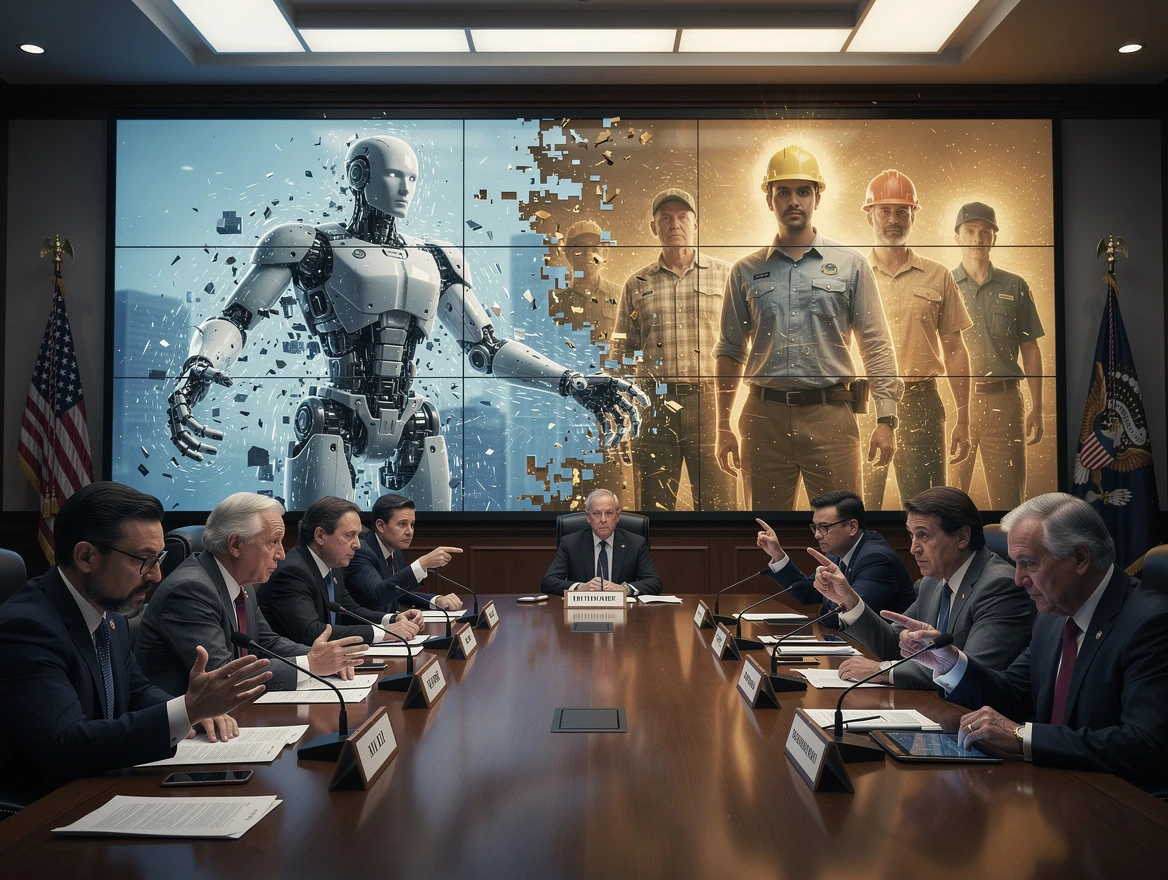
On April 6, 2026, OpenAI released a 13-page policy document titled “An Industrial Policy in the Age of Intelligence: Ideas to Prioritize Humanity”. This text, unveiled as the company finalizes a record $122 billion fundraising round and boasts a valuation of $852 billion, proposes concrete measures to cushion AI’s impact on employment. Sam Altman, CEO of OpenAI, presented it not as a fixed plan but as a starting point for public debate. In Washington, the reception is chilly: many see it as a wish list from a nearly trillion-dollar company rather than a credible program.
Key takeaways:
- OpenAI proposes a robot tax and a national public wealth fund to redistribute AI profits to citizens.
- The 32-hour workweek without salary loss is presented as a government pilot to absorb AI productivity gains.
- The proposals are met with skepticism in Washington, seen as a wish list without binding force.
- Sectors like IT, law, and finance are exposed: 16% of French jobs will undergo major transformations according to Coface.
- The timing coincides with OpenAI’s preparation for a stock market debut, fueling doubts about the sincerity of the approach.
A 13-page document raising unprecedented questions
What OpenAI published on April 6, 2026, goes beyond the usual corporate communications. The document directly addresses three topics Silicon Valley has avoided until now: the redistribution of wealth generated by AI, the taxation of technological capital, and the reduction of working hours. Chris Lehane, OpenAI’s director of international affairs, stated during a Bloomberg appearance that the political debate must be “as transformative” as the technology itself.
The text revolves around three central objectives:
- Distribute the prosperity generated by AI to the entire population, not just shareholders.
- Reduce systemic risks associated with massive and rapid automation.
- Ensure universal access to AI to prevent excessive concentration of economic power.
The context is clear: the US Congress is about to debate AI regulation legislation, and companies like Block and Atlassian have already cited AI to justify layoffs. OpenAI speaks of a wave of job cuts it calls the “SaaSpocalypse”. The document arrives at the right time to position the firm as a responsible player, just months before a possible IPO.
Robot tax, public fund: three flagship measures
OpenAI’s concrete proposals on employment are bold on paper. The first is a automation tax, inspired by an idea from Bill Gates in 2017: a robot replacing a human would pay the same taxes as that human. The goal is to preserve the labor tax base as wage income risks collapsing in favor of corporate profits. Recall that the US corporate tax rate has been 21% since the Trump-era reforms, down from 35% previously.
The second measure is the creation of a national public wealth fund, funded by a fraction of AI companies’ profits. This fund would directly distribute income to American citizens and finance weakened public services, primarily Social Security and Medicaid, whose tax bases could collapse if corporate profits explode without appropriate taxation.
The third proposal is a 32-hour workweek pilot project, or four days, without a pay cut. OpenAI encourages governments to test this model so that AI-related productivity gains translate into free time rather than overproduction. Employers would be encouraged to share these gains as “profit bonuses” and increase their retirement contributions or coverage of health and childcare costs.
Takeaway: OpenAI’s robot tax specifically targets capital, not labor. It aims to shift the tax burden from wages to AI revenues, capital returns, and high capital gains, to preserve programs like SNAP or housing assistance.
Washington’s skepticism: between mistrust and political realism
On Capitol Hill, OpenAI’s proposals are met with marked caution. Several observers and lawmakers label them a “wish list”: a list of generous ideals from a company valued at $852 billion, without binding mechanisms or a precise timeline. The timing doesn’t help: releasing an ambitious social plan just before a stock market debut looks more like a PR move than a firm commitment.
On substance, several political obstacles are real:
- A robot tax would face fierce opposition from tech lobbies and investment funds, some of which have already fought similar proposals under the Biden administration.
- The creation of a national sovereign fund is foreign to American fiscal culture, traditionally hostile to any form of centralized redistribution.
- A four-day workweek piloted by the federal government would require a difficult-to-form parliamentary coalition in the current context.
Sam Altman himself has framed these proposals as an open debate, not a legislative program ready for a vote. This cautious positioning reflects a reality: OpenAI needs Washington as much as Washington needs OpenAI. AI regulation is imminent, and the company prefers to be at the negotiating table rather than across from it.
To better understand how OpenAI builds its tools capable of automating complex tasks, read our analysis on OpenAI Operator, the autonomous agent for your online tasks.
What the data really says about employment in 2026
The figures available in April 2026 paint a nuanced picture, far from catastrophic speeches or euphoric promises. In France, a study by Coface published in early April 2026 reveals that 16% of jobs, out of 923 professions analyzed, will undergo major transformations. The most exposed sectors are IT, administrative functions, law, and finance, where more than a quarter of work content is automatable.
The April 2026 HiringLab report adds an important structural data point: the global labor market has returned to its February 2020 level, with a 50% drop in job offers since the December 2022 peak. But within this general decline, offers mentioning AI are increasing. In France, they reach 3.4% of the total, compared to 7.5% in the UK and 4.9% in the US. In tech, marketing, and HR, the increase is 6 to 8 points in a year.
| Indicator | France | UK | US |
|---|---|---|---|
| Job offers mentioning AI | 3.4 % | 7.5 % | 4.9 % |
| ChatGPT’s share in generative AI | 55 % | N/A | N/A |
| Youth jobs (15-29 years) excluding apprenticeships | -7.4 % in 1 year | N/A | -20 % (developers) |
The 7.4% decline in employment for 15-29-year-olds in France, excluding apprenticeships, documented by Insee, primarily affects young IT developers whose junior tasks (coding, documentation, testing) are absorbed by AI models. This phenomenon is mirrored in the US, where entry-level software development positions have dropped by 20%.
Warning: The rise in AI job offers does not offset the overall market contraction. It creates new opportunities for experienced profiles capable of integrating AI, but structurally penalizes newcomers without experience.
OpenAI facing its own contradictions
The paradox is hard to ignore. OpenAI is one of the companies most actively accelerating the disruption of jobs it proposes to protect. Its autonomous agents, capable of executing multi-step tasks without human intervention, are already transforming workflows in entire sectors.
In terms of staffing, OpenAI plans to nearly double its own workforce by the end of 2026: from 4,500 to 8,000 employees in engineering, research, product development, and sales. This is against the trend of layoffs at HP (6,000 planned cuts), Amazon (16,000), or Meta (15,800), all citing AI as an efficiency lever.
OpenAI also proposes that companies automating jobs assume new social responsibilities: increase retirement contributions, cover more health costs, subsidize childcare and eldercare. When a job is automated, the benefits tied to that position disappear for the worker. This “corporate responsibility” aspect complements the proposals addressed to governments but remains voluntary, which immediately limits its real impact.
The document also mentions the need to accelerate the expansion of the US electrical grid, under increasing strain due to data centers and the energy needed to train ever more powerful models. This is an infrastructure demand that would directly benefit OpenAI, and it reminds us that the April 6 plan intertwines general interest and commercial interest in an inseparable way.
Conclusion
OpenAI’s document from April 6, 2026, has the merit of existing. For the first time, one of the central players in AI puts on the table quantified and structured proposals on redistribution, taxation, and work organization. The robot tax, public wealth fund, and 32-hour workweek are not trivial ideas: they point to profound transformations that most tech companies still refuse to publicly address.
But Washington’s skepticism is not unfounded. These proposals come from a company valued at $852 billion, preparing for a stock market debut, and whose products directly fuel the destruction of the jobs it claims to want to protect. Without binding mechanisms, without a legislative timeline, without a visible political coalition, this document remains for now a framework for reflection. What it becomes will depend less on OpenAI than on American lawmakers and their ability to turn a debate into law.
FAQ
What is the OpenAI policy document published in April 2026?
It is a 13-page document published on April 6, 2026, titled “An Industrial Policy in the Age of Intelligence: Ideas to Prioritize Humanity”. It proposes measures to mitigate the impact of AI on employment: robot tax, national public wealth fund, 32-hour workweek, and automatic social protection mechanisms. Sam Altman presented it as a starting point for public debate, not as a legislative program ready for a vote.
How does the robot tax proposed by OpenAI work?
Inspired by an idea from Bill Gates in 2017, this tax proposes that a robot or AI system replacing a human worker be subject to the same taxation as that worker. The goal is to preserve the labor tax base as wage income decreases in favor of corporate profits. This would help maintain funding for programs like Social Security, Medicaid, SNAP, or housing assistance.
Which sectors are most threatened by AI in France in 2026?
According to a study by Coface published in early April 2026, 16% of jobs in France across 923 professions analyzed will undergo major transformations. The most exposed sectors are IT, administrative functions, law, and finance, where more than a quarter of work content is automatable. Insee also documents a 7.4% decline in employment for 15-29-year-olds excluding apprenticeships in one year, primarily affecting young developers.
Why are OpenAI’s proposals met with skepticism in Washington?
Several reasons fuel this mistrust. First, the timing: the document is released shortly before a likely stock market debut, making it look like a PR move. Then, the proposals are voluntary and without a binding timeline. Finally, a robot tax and a federal sovereign fund clash with American fiscal culture and the predictable opposition of tech and financial lobbies. Many lawmakers see them as a “wish list” without real legislative grounding.
Is OpenAI hiring despite AI’s impact on employment?
Yes. Contrary to massive layoffs at HP, Amazon, or Meta, OpenAI plans to nearly double its workforce by the end of 2026, from 4,500 to 8,000 employees. The hiring targets engineering, research, product development, and sales. This expansion aims to support companies in integrating AI and prepare for the merger of ChatGPT, Atlas, and Codex products into a unified desktop application, in anticipation of a stock market debut.
Related Articles

Seedance 2.0: The video generation model shaking up the film industry
Seedance 2.0 isn’t just another tool in the list of AI video generators. It’s the model developed by ByteDance that made Hollywood tremble even before it was available to the…

Mistral offers 22 ideas to make Europe the AI leader
On April 7, 2026, Mistral AI released a document titled European AI: a playbook to own it, available at europe.mistral.ai. This text contains exactly 22 concrete proposals to transform Europe…