
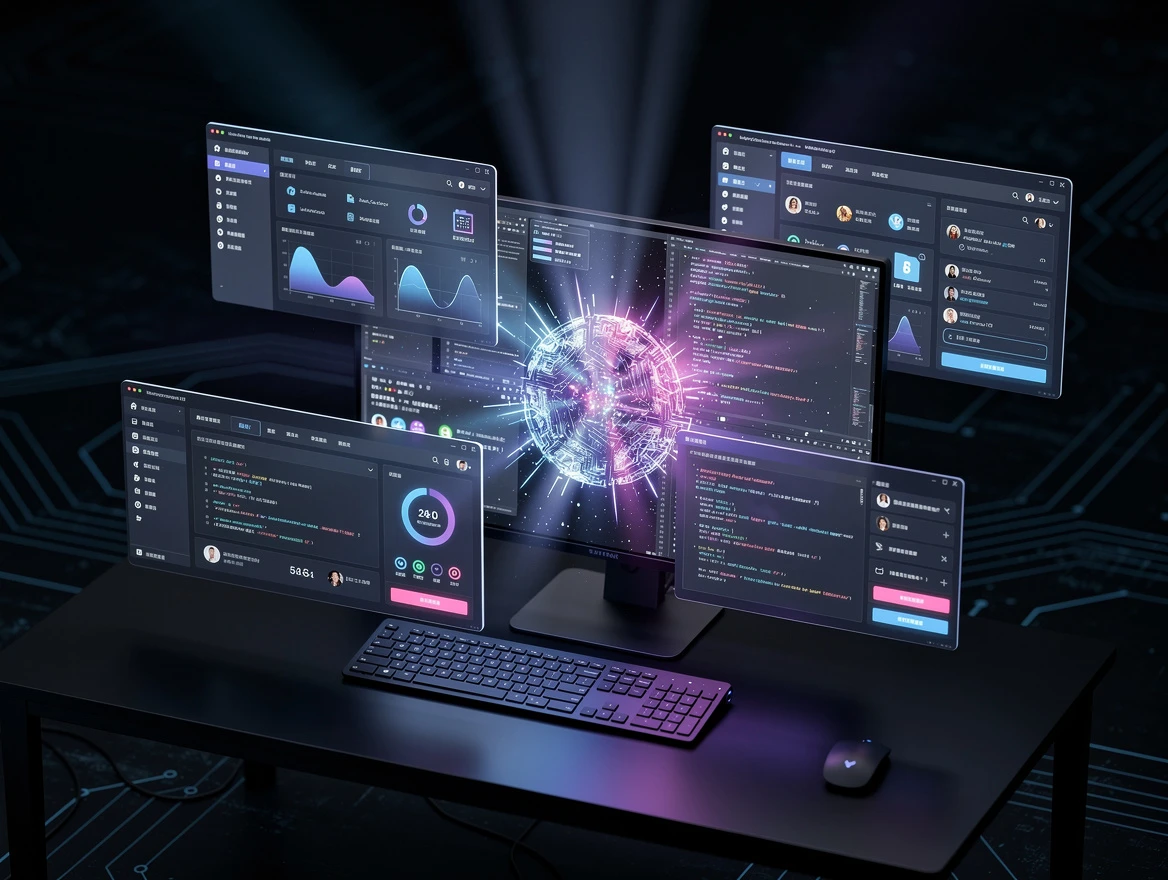
On February 25, 2026, Perplexity reached a milestone that AI observers had been anticipating for months: transitioning from a conversational search engine to an autonomous digital computer. Perplexity Computer is not just an enhanced chatbot. It’s an orchestration system that recruits specialized AI agents, delegates sub-tasks to them, and delivers a complete result while the user does something else. A full marketing campaign, a coded and deployed application, a multi-source financial analysis: Computer handles all of this without constant supervision.
Key takeaways:
- Perplexity Computer orchestrates over a dozen specialized AI models to autonomously execute entire projects.
- The main reasoning engine is Anthropic’s Claude Opus 4.6, surrounded by Gemini, GPT-5.2, Grok, and Veo 3.1 depending on the task.
- Everything runs in an isolated cloud environment (sandbox), without touching the user’s local hardware.
- Three versions coexist: standard Computer, Personal Computer on Mac mini, and Computer for Enterprise with Salesforce/Snowflake connectors.
- Access is reserved for Perplexity Max subscribers, with Pro and Enterprise deployment announced in the weeks following the launch.
What Perplexity Computer really changes
Before Computer, using multiple AIs on a complex project felt like manual juggling: ChatGPT for text, Midjourney for visuals, a separate coding tool, with the user as an impromptu conductor. Computer fully automates this coordination.
The system receives a natural language instruction, breaks it down into sub-tasks, selects the most suitable model for each, and executes everything asynchronously. It can run dozens of tasks in parallel for months, contacting the user only for critical validation. The rest of the time, it operates independently.
Dmitry Shevelenko, Perplexity’s commercial director, summarizes the ambition: a tool that actually acts rather than just producing answers. It’s the difference between an assistant drafting an email and an agent analyzing your CRM, drafting the email, sending it to the right segment, and generating a performance report.
For more on comparing current agent-based approaches, the article OpenAI Operator vs Anthropic Computer Use: the battle of AI agents offers a useful complementary perspective.
The multi-model architecture: who does what
The real technical advantage of Perplexity Computer lies in its ability to automatically route each sub-task to the most efficient model for that specific task. It’s not a single LLM doing everything: it’s a coordinated fleet.
| Model | Provider | Role in Computer |
|---|---|---|
| Claude Opus 4.6 | Anthropic | Main reasoning and planning |
| Gemini | In-depth research and sub-agent creation | |
| GPT-5.2 | OpenAI | Long contexts and exhaustive web search |
| Grok | xAI | Light and fast tasks |
| Veo 3.1 | Video generation | |
| Nano Banana | Image processing |
Concrete example: you ask Computer to create a marketing video for a product. Claude Opus 4.6 plans the project, Gemini researches market data, Nano Banana processes reference visuals, and Veo 3.1 generates the final video. No manual intervention between these steps.
The user can also manually choose which model handles which sub-task, allowing for cost optimization in tokens: Grok for a simple task, GPT-5.2 only when long context is needed.
Tip: To reduce costs on multi-hour projects, explicitly assign Grok to micro-tasks like sorting or formatting. Reserve Claude Opus 4.6 and GPT-5.2 for complex reasoning stages. The integrated spending dashboard helps you monitor consumption in real time.

Three versions for three distinct uses
Perplexity didn’t launch just one product on February 25, 2026. It launched three variants of Computer, each targeting a different usage profile.
Standard Computer: the isolated cloud
The basic version operates entirely in the cloud within an isolated sandbox environment. It has a real file system, a browser, and controlled tool integrations. It doesn’t access the user’s local hardware, eliminating machine chaos risks while limiting some offline uses. It’s the safest model, comparable to an App Store filtering authorized integrations.
Personal Computer: the permanent agent on Mac mini
Personal Computer deploys an AI agent 24/7 on a dedicated Mac mini, connected to local files, sessions, and tools. It can continue tasks even offline. Controllable from any device via the Perplexity app, it includes precise safeguards:
- Mandatory approval for any sensitive action
- Complete audit log per session
- Emergency stop button to regain control immediately
Typical use case: continuously analyzing data files to generate automatic weekly reports without any user presence.
Computer for Enterprise: business connectors
The Enterprise version connects the agent to professional tools via application connectors. Compatible with Snowflake, Salesforce, HubSpot, and hundreds of other platforms, it allows automating entire team workflows without infrastructure overhaul. A real example: automatically extracting data from Snowflake, analyzing it, and pushing the results into Salesforce as a structured report.
For developers looking to build on this infrastructure, Perplexity offers an API in four components: Search (sourced web retrieval), Agent (autonomous multi-step delegation), Sandbox (isolated execution), and Embeddings (ranking and relevance).
Computer versus its direct competitors
The launch of Perplexity Computer comes in a specific context: the virality of OpenClaw triggered a race for personal AI agents, pushing dozens of similar projects on GitHub and forcing players like Meta to pivot. Perplexity positions itself as the secure cloud version where OpenClaw plays the local open-source card.
Perplexity Computer vs OpenClaw
OpenClaw runs locally on the user’s hardware, with direct access to the terminal and files. Powerful but risky: a poorly formulated instruction can affect the system. Computer confines everything to the cloud, eliminating this risk at the cost of limiting offline uses and access to sensitive personal files. Computer’s multi-model orchestration is also structurally superior: OpenClaw generally relies on a single model, while Computer intelligently routes between over a dozen cutting-edge models.
On the topic of local agents, Anthem Creation’s article on Anthropic Computer Use explores a complementary approach worth knowing.
Perplexity Computer vs Manus AI
Meta’s Manus AI occupies the same category of large-scale autonomous agents. The main difference: Perplexity focuses on open multi-model orchestration (Anthropic + Google + OpenAI + xAI in the same system), while Manus relies more on Meta’s internal infrastructure. For workflows requiring the best available model at each stage, Computer has a structural edge.
Caution: Perplexity Computer can make typical AI system errors. Outputs should be verified before final use, and backups should be made before executing on important data. Sensitive actions always require explicit user approval.

Access, pricing, and what we really know
At its February 2026 launch, Perplexity Computer is reserved for Perplexity Max subscribers, the premium offer positioned for intensive users. Deployment to Pro and Enterprise subscribers was planned in the weeks following the launch.
Pricing is based on a two-tier model:
- The basic subscription (Max) provides access to the platform
- Usage credits cover the actual token consumption per model
This usage-based model allows controlling expenses on long projects. The integrated dashboard displays real-time consumption per sub-task, helping to identify costly steps and optimize them.
No hardware prerequisites are needed for the standard version: everything is done through the browser, without local GPU, without installation. Compatibility is universal — Mac, Windows, Linux, mobile.
To compare Perplexity’s deep research capabilities with its direct competitors, the article Deep Research: Perplexity, OpenAI, Gemini, who is the best? provides concrete comparison elements.
Conclusion
Perplexity Computer marks a real turning point in what AI tools can autonomously do. The multi-agent orchestration, intelligent routing between Claude Opus 4.6, GPT-5.2, Gemini, and others, parallel execution over months: all this represents a serious architecture, not a marketing product. The three versions (standard, Personal Computer, Enterprise) cover needs ranging from freelancers to entire departments. Limitations exist: local file access is restricted, AI errors are possible, and dependency on third-party models creates availability risks. But for those looking to automate complex workflows without tinkering with five separate tools, Perplexity Computer is currently one of the most advanced architectures on the market.
FAQ
What exactly is Perplexity Computer?
Perplexity Computer is a multi-agent orchestration system launched on February 25, 2026. It breaks down a complex instruction into sub-tasks, delegates each to a specialized AI model (Claude Opus 4.6, GPT-5.2, Gemini, Grok, Veo 3.1…), and executes everything autonomously in an isolated cloud environment. Unlike a chatbot, it doesn’t wait for questions: it makes decisions, codes, researches, generates files, and delivers complete results.
How does the sub-agent system work in Computer?
Claude Opus 4.6 handles the main reasoning and planning. It then generates specialized sub-agents for each stage: Gemini for research, Grok for quick micro-tasks, GPT-5.2 for long contexts, Nano Banana for images, Veo 3.1 for videos. This delegation is automatic and parallel. The user can also manually force the assignment of a model to a sub-task to optimize costs.
What is the difference between standard Computer and Personal Computer?
Standard Computer runs entirely in the cloud in an isolated sandbox, without access to local hardware. Personal Computer, on the other hand, runs on a dedicated Mac mini connected to the user’s local files and sessions. It can operate offline and continuously, with safeguards like an emergency stop button and a complete audit log. Both can be controlled from the Perplexity app on any device.
Is Perplexity Computer safer than OpenClaw?
In terms of machine security, yes. OpenClaw runs locally with direct terminal access, creating risks if an instruction is poorly formulated. Computer confines all actions to the cloud in a closed environment, with filtered integrations and required approval for sensitive actions. In return, it doesn’t freely access local personal files, limiting some offline uses.
Who is Computer for Enterprise aimed at?
Computer for Enterprise targets teams already using tools like Salesforce, HubSpot, or Snowflake and wanting to integrate agent-based AI without technical overhaul. Through application connectors, the agent can extract data, analyze it, and push results directly into these platforms. It’s designed to automate recurring workflows at the scale of an entire department, with the same multi-model architecture as the standard version.
Related Articles

How Muse Spark is transforming health reasoning with 1000 physician curators
On April 8, 2026, Meta unveiled Muse Spark, the first model from its Meta Superintelligence Labs. After nine months of complete reconstruction and a shift towards proprietary technology, this native…

Seedance 2.0: The video generation model shaking up the film industry
Seedance 2.0 isn’t just another tool in the list of AI video generators. It’s the model developed by ByteDance that made Hollywood tremble even before it was available to the…