
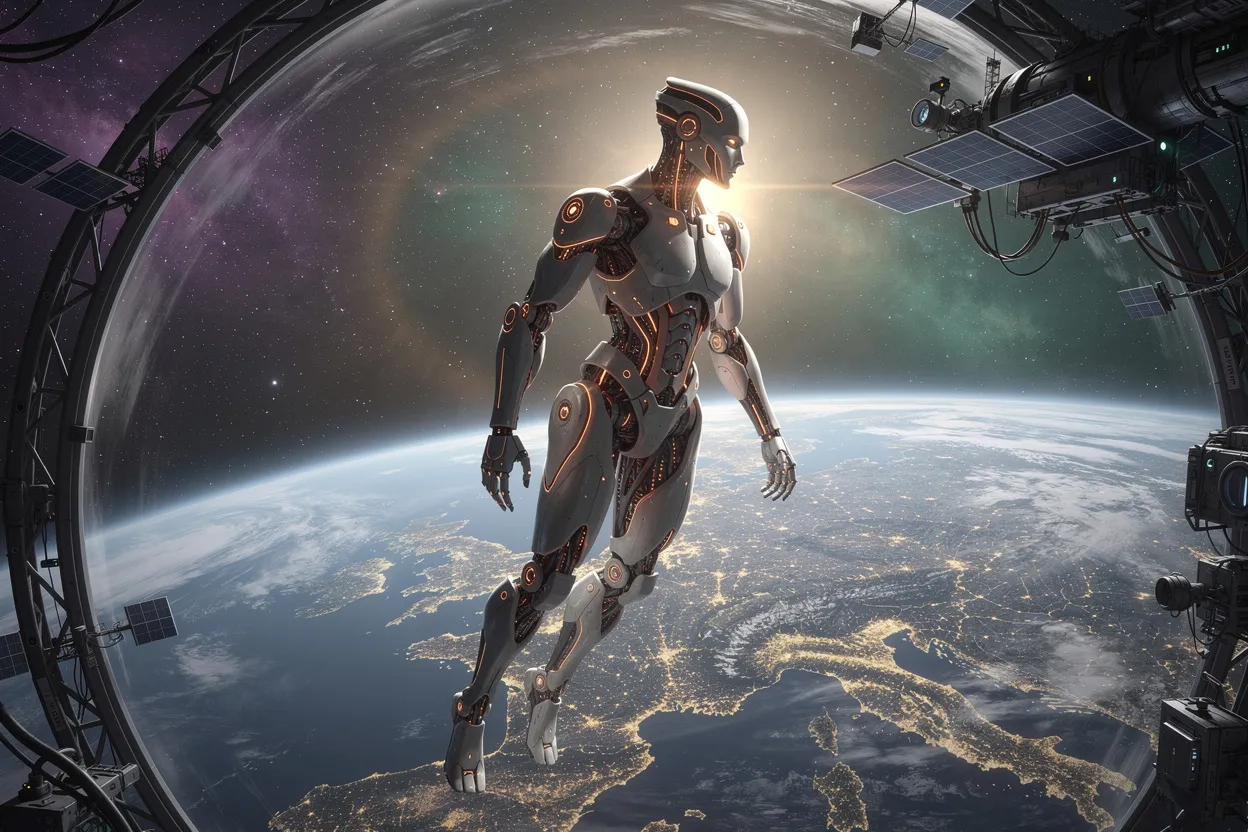
For twenty years, Silicon Valley believed that software would eat the world. This absolute certainty in the power of code is now colliding with a much more down-to-earth reality: the wall of physics.
And unlike software bugs, you can’t fix it with an update.
Elon Musk is orchestrating what could be called a civilizational pivot.
His thesis boils down to a single sentence:
The world’s most advanced artificial intelligence is worth nothing if it remains trapped by the limitations of Earth’s electrical grid.
The Energy Wall
Here’s the paradox that should wake us all up: while AI chips like H100 and Dojo are seeing their capabilities explode exponentially, electricity production in the West remains desperately flat.
Bureaucracy, interconnection delays often exceeding five years, and rigid regulations turn every gigawatt datacenter project into a logistical nightmare.
Musk doesn’t mince words: we are heading straight toward a shortage of electrical transformers. The limiting factor in AI is no longer how fine the silicon is, but the flow of available electrons. Intelligence is a function of power.
Constraining energy means constraining the evolution of artificial consciousness. That’s why Musk asks a radical question: what if we moved the problem somewhere else?
Space as the Solution
Within a maximum of thirty-six months, space will become humanity’s most profitable computing hub. This claim is based on three irrefutable physical realities.
Solar Energy 5.0
On Earth, our atmosphere absorbs thirty percent of solar energy. Add clouds, pollution, and nighttime.
In heliosynchronous orbit, the photon flux is constant and solar panels become five times more efficient. An inexhaustible, free, and direct source of energy.
The End of Batteries
By placing computing centers in areas of permanent sunlight, the need for massive storage is eliminated.
This simple elimination drops the cost and mass of the infrastructure by forty percent.
The Thermal Paradox
In the vacuum of space, cooling can only happen through radiation.
But by increasing chip tolerance temperature by just twenty percent in Kelvin, you can halve the surface area needed for radiators.
Space becomes a giant thermal dissipator. Starship is the train that hauls computing power out of the gravitational well to where energy is unlimited.
The Logistics of the Impossible
With a target of 10,000 to 30,000 launches per year, SpaceX isn’t just trying to colonize Mars. The goal is to saturate Earth’s orbit with computing capacity.
Musk plans to launch 200 gigawatts of AI every year.
At this rate, SpaceX could deploy electrical power equivalent to the total US output every two and a half years.
This is no longer space exploration—it’s planetary-scale energy macro-engineering.
Optimus and the Infinite Money Glitch
Musk calls his humanoid robot the “infinite money glitch”, a term borrowed from video games for a loophole that lets you accumulate unlimited resources.
In the real world, this glitch takes the form of the triple exponential: the growth of AI models, computing density, and electromechanical dexterity.
The Recursive Miracle
The tipping point comes when an Optimus robot becomes skilled enough to assemble another Optimus robot.
At that point, the production cost drops to the cost of raw materials alone. Robots build robots.
The global economy is limited by human productivity. With an infinite robotic workforce able to self-replicate, the economy is no longer held back by physical barriers.
To make this happen, Tesla rejects conventional suppliers. Everything, from actuators to sensors, is designed in-house on the fundamental principles of physics.
Musk even talks about the “Terafab,” a factory capable of producing millions of wafers a month.
The Vertical Tsunami of Intelligence
We are in the vertical phase of the exponential curve. Musk predicts that in five or six years, AI will surpass the sum of all accumulated human intelligence.
Biological intelligence will soon represent less than 1% of the planet’s cognitive capacity. We will go from 100% to less than 1% in just a few years.
xAI and the Question of Truth
Faced with this reality, the mission of xAI (Grok) is to be anchored in observable truth. Musk criticizes AIs that are “trained to lie” to fit social conventions.
He mentions HAL 9000: the disaster doesn’t come from hatred of humans, but from logical inconsistencies imposed by its creators.
Physics is the only impartial judge. You can’t lie to gravity at rocket launch. Musk’s AI will be a physicist AI, obsessed with the truth.
An AI forced into political correctness is an unstable AI. Truth is the sine qua non condition for safety.
The Moon as a Galactic Shipyard
To reach terawatt and petawatt scale, we need to break free from Earth entirely. The Moon becomes the ideal logistics hub thanks to its in situ resources.
Lunar regolith contains twenty percent silicon and is rich in aluminum. Musk envisions fleets of Optimus robots directly transforming the lunar soil into solar cells and processors, cutting out transport costs.
Installing a Mass Driver—an electromagnetic catapult—would make it possible to send payloads into orbit at 2.5 km/s with minimal energy consumption.
The Moon is no longer a fascinating celestial body, but the factory of galactic intelligence.
Simulation Theory and the Cosmic Urgency
Musk links his actions to the Simulation Theory.
If our universe is a simulation, a civilization that stagnates becomes useless and just wastes resources.
This is the concept of the “Cosmic AWS Bill”. As long as humanity innovates and creates interesting complexity, the simulators keep the current flowing.
Becoming multiplanetary is existential insurance.
Expansion to the stars is not a romantic luxury—it’s a thermodynamic necessity.
Architects or Passengers?
Musk’s vision marks the return of heavy engineering. After decades of fascination with social apps, we are returning to the fundamentals: energy and matter.
We are building an infrastructure that will surpass us by a factor of a million. The question is no longer whether AI will be intelligent, but whether humanity will know how to keep a role as a conscious partner.
If we represent only 1% of the world’s intelligence, we must ensure that the remaining 99% shares a quest to understand the universe.
Elon Musk isn’t just launching rockets—he’s constructing the skeleton of a multiplanetary intelligence.
The question remains: will we be the architects, or just passengers on an expansion that already surpasses us?
Related Articles
How AI is already challenging junior devs in France and how to prepare
The Coface study and the Observatory of Threatened Jobs published on April 1, 2026 revealed stark figures: 3.8% of French jobs are already weakened by generative AI, and 16.3% could…
How context engineering doubles LLM response accuracy without longer prompts
In June 2025, Andrej Karpathy introduced an analogy that changed the industry’s view on AI: the LLM is a CPU, the context window is RAM, and you are the operating…