

Since July 22, 2026, Google’s AI Overviews and AI Mode have been active in France, and the question of the difference between SEO and GEO has moved from expert debate to boardroom discussion.
SEO (Search Engine Optimization) focuses on your position in a list of results.
GEO (Generative Engine Optimization) focuses on your position in a response written by artificial intelligence.
The difference can be summed up in one sentence, but its impact on the daily work of a corporate website deserves a closer look.
SEO seeks a click, GEO seeks a citation
For twenty years, SEO had one goal: to appear at the top of a page of ten blue links and get the click.
The measurement was simple: a position, a volume of impressions, a click-through rate, a visit.
A generative engine like ChatGPT, Perplexity, or Google’s AI Mode doesn’t present a list; it writes a response.
Your content is no longer ranked; it is cited, summarized, sometimes paraphrased without any link.
The term GEO comes from a Princeton researchers’ article published in November 2023, which already measured the visibility of a source within generated responses rather than its position in a list.
SEO gets you into the list. GEO gets you into the sentence.
This shift has a measurable cost: According to the Pew Research Center (July 2025), a user clicks on a result in 8% of Google searches displaying an AI summary, compared to 15% when there isn’t one.
Links cited within the summary itself are clicked only 1% of the time.
Being cited doesn’t bring back lost traffic, but not being cited erases you from a growing share of searches.
Two systems that don’t read your site the same way

A traditional search engine works like a library: It explores, indexes, then ranks entire pages based on hundreds of signals.
A generative engine works like a rushed research assistant: It launches a few queries, retrieves a handful of documents, extracts passages, then writes.
The first judges a page, the second judges a paragraph.
AI Mode goes further: It breaks your question into several sub-queries launched in parallel, multiplying the chances of being selected for a specific point, and never for a “generalist” page.
This is why a well-ranked article may never be cited, while a page relegated to Google’s third page might be cited weekly.
The generative engine selects a passage when it directly answers the question, contains a verifiable fact, and clearly identifies who and what it is about.
It skips introductions that skirt the topic, undated pages, and vague formulations that offer nothing to cite.
A well-ranked but vague page stays on the bench. A precise paragraph gets on the field.
What changes concretely in the work
Here’s what we observe, point by point, when transitioning from an SEO project to a GEO project on the same site.
| SEO | GEO | |
|---|---|---|
| Goal | A position in results | A citation in the response |
| Unit of work | The page | The passage (paragraph, table, definition) |
| Winning format | Complete content, well-linked | Direct answer upfront, dated facts, named sources |
| Authority signals | Inbound links, domain age | Mentions on third-party sites, entity coherence |
| Freshness | Useful | Decisive on evolving topics |
| Measurement | Positions, clicks, sessions | Citation frequency, share of voice, accuracy of mentions |
| Surfaces | Google, Bing | ChatGPT, Perplexity, Gemini, Claude, Copilot, AI Overviews, AI Mode |
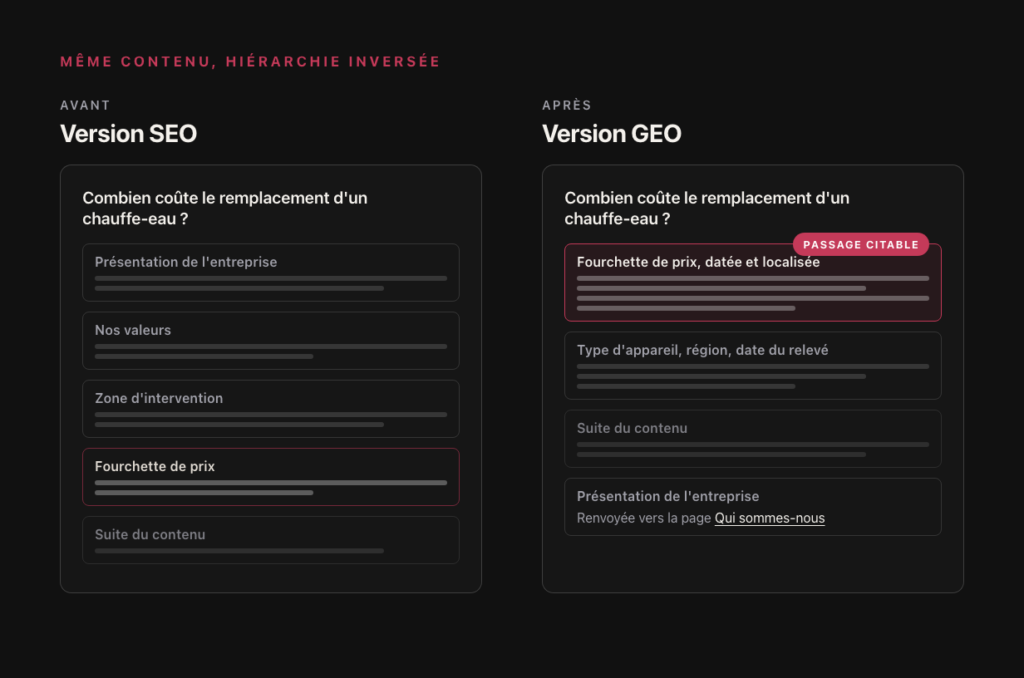
Let’s take a concrete example: A heating technician publishes a page “How much does it cost to replace a water heater?”
The SEO version starts with three paragraphs presenting the company, its values, and its service area, then gives a price range in the middle of the page.
The GEO version starts with the range itself, including the date of the survey, the region, the type of device, and refers to the “about us” page for the rest.
The content is the same, the hierarchy is reversed, and only the second version has a chance of being quoted verbatim in a generated response.
The “measurement” line in the table is the hardest to maintain because no Search Console tells you how many times ChatGPT has cited you.
You need to query the engines on your key queries, note the sources selected, and repeat every month.
We keep this record in a deliberately simple table: Query, engine, cited sources, citation’s place in the response, date of the record.
What doesn’t change
GEO doesn’t replace SEO; it builds on it.
Generative engines draw from the same indexes: A slow page, blocked to robots, or unreachable doesn’t exist for either.
Internal linking, loading times, and a clean sitemap remain the first condition to be read, by an indexing robot or a search agent.
Princeton researchers measured up to 40% more visibility in generated responses for content that cites its sources, adds statistics, and relies on named expertise.
These three levers are exactly what quality SEO has recommended for years under the name E-E-A-T (experience, expertise, authority, trustworthiness).
Conversely, keyword stuffing and filler content reduce visibility in both worlds.
Good SEO content is already, two-thirds of the way, good GEO content. The remaining third is a matter of form.
How we approach GEO at the agency
We don’t sell a separate “GEO strategy”; we add four steps to each piece of content produced.
- Answer in the first sentence of each section, before elaborating, to provide a passage ready for extraction.
- Date and source each figure, with the organization’s name and year, so an engine can attribute it.
- Name entities unambiguously (brand, product, place, person) and declare them in Schema.org structured data.
- Track citations monthly on about ten queries, in ChatGPT, Perplexity, and AI Mode, just like tracking positions.
On a small business showcase site, this work takes half a day per content and requires no redesign.
We described this evolution as soon as the Search Generative Experience, now AI Overviews, appeared, and the arrival of AI Overviews in France in July 2026 confirms the trajectory.
The role of the website changes with it: We detailed this in The end of websites? No, but their role has changed.
The site remains the source. What changes is who reads it first: a human, or a machine speaking on its behalf.
Key takeaways
SEO aims for a position in a list, GEO aims for a citation in a response.
The first judges the page, the second judges the passage.
The foundations are shared: An explorable site, accurate content, named sources.
The difference lies in the content’s form and how it’s measured, not in a new discipline to buy.
Start with your ten most visited pages: A response at the top of each section, a date, a named source, then a citation record the following month.
If you’re already publishing serious content, you’re closer to GEO than you think: It just needs to be made citable.