

Anthropic released Claude Opus 5 on July 24, 2026.
The announcement is simple: the model approaches the intelligence of Claude Fable 5 at half the price.
Put this way, the news mostly interests developers.
For a manager developing a website, a business tool, or automation, it deserves translation into billing and timeline terms.
What’s changed, in three figures
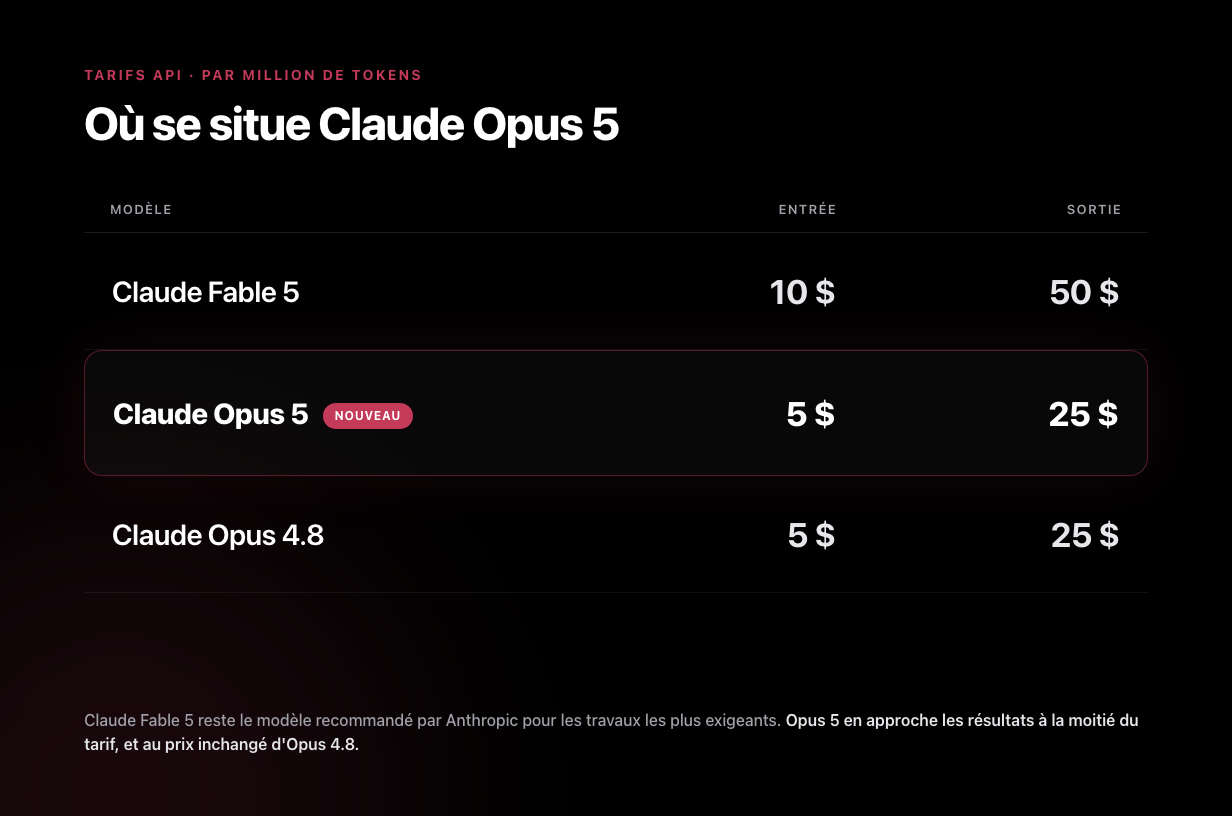
The API rate for Claude Opus 5 is set at $5 per million input tokens and $25 per million output tokens.
This is exactly the rate of Claude Opus 4.8, the previous generation.
The context window goes up to 1 million tokens, which is both the default and the maximum value, with 128,000 tokens possible for responses.
A token roughly equals three-quarters of a word in French, placing this window around the equivalent of several thousand pages.
A generational leap without a price increase: this is the only point in the press release that directly impacts billing.
The comparison with Anthropic’s high-end models clarifies the positioning.
| Model | Input (per million tokens) | Output (per million tokens) |
|---|---|---|
| Claude Opus 4.8 | $5 | $25 |
| Claude Opus 5 | $5 | $25 |
| Claude Fable 5 | $10 | $50 |
Anthropic announces that on its agent coding evaluation Frontier-Bench v0.1, Claude Opus 5 doubles the performance of Opus 4.8.
On CursorBench 3.2, the publisher indicates that the model is within 0.5% of Fable 5’s best score, at half the cost per task.
These figures come from the publisher and not an independent lab, suggesting they should be seen as a direction rather than a contractual guarantee.
Why stable pricing matters more than benchmarks
For the past two years, each model generation brought increased capabilities with a higher price tag.
A provider’s calculation then resembled a trade-off: either quality or the client’s budget.
With the same price as the previous generation, this trade-off disappears on this specific point.
If your agency billed an automation project using Opus 4.8, it now works with a more capable model at the same consumption cost.
The right question isn’t “are you using the latest model,” but “what does the latest model make possible in my project.”
A technical detail has very concrete billing consequences: the minimum caching threshold for a prompt drops to 512 tokens, down from 1,024.
Short, repeated instructions, typical of a support chatbot or an intelligent form, become eligible for caching and cost significantly less per call.
If your provider has never mentioned caching to you, it’s a topic to discuss, and we’ve detailed concrete levers to manage a Claude API bill in a dedicated article.
What your provider can now do that they couldn’t before
The gains announced by Anthropic focus on lengthy tasks, where a model previously needed hand-holding.
Development that goes the distance
The model is presented as capable of handling a feature spread across multiple files, or a major technical overhaul, without leaving unfinished code blocks behind.
Translated to the client side, this means fewer back-and-forths between “it’s done” and “actually, half is missing.”
Useful code review
Anthropic highlights a high rate of real bugs detected per pass, with few false alerts, even at economical settings.
An automated review before production costs a few euros and sometimes prevents a regression visible to your clients.
Accurate visual reading
The understanding of charts, documents, and diagrams is improving, as is the reproduction of interfaces from a mockup.
This is the logical continuation of what we observed with the Opus 4.7 generation in design and front-end integration.
Usable office deliverables
Multi-sheet spreadsheets with non-trivial formulas and structured presentations are among the highlighted capabilities.
For an SME, this is often where the real gain hides: the monthly report, the quote template, the tracking table that no one has time to maintain.
The best first AI project is almost never a chatbot: it’s the repetitive task your team endures every week.
Entire files processed in one go
The million-token context stops being a spec line when translated into documents.
A specification, its appendices, the maintenance contract, and six months of email exchanges fit into a single request.
Anthropic indicates that instruction following and tool calling remain consistent throughout the window’s length, which was a weak point of previous generations.
Practically, a compliance audit or a bid response analysis no longer needs to be sliced into parts by a developer.
Multiple agents that don’t step on each other
The coordination of sub-agents is improving, with setups where one agent produces and another verifies.
This was the missing piece for slightly ambitious automations, where two agents ended up overwriting each other’s work.
If you’re interested, we’ve described how Anthropic’s managed agents work and their real use cases.
The effort slider, your new budget lever
Claude Opus 5 offers five effort levels: low, medium, high, xhigh, and max.
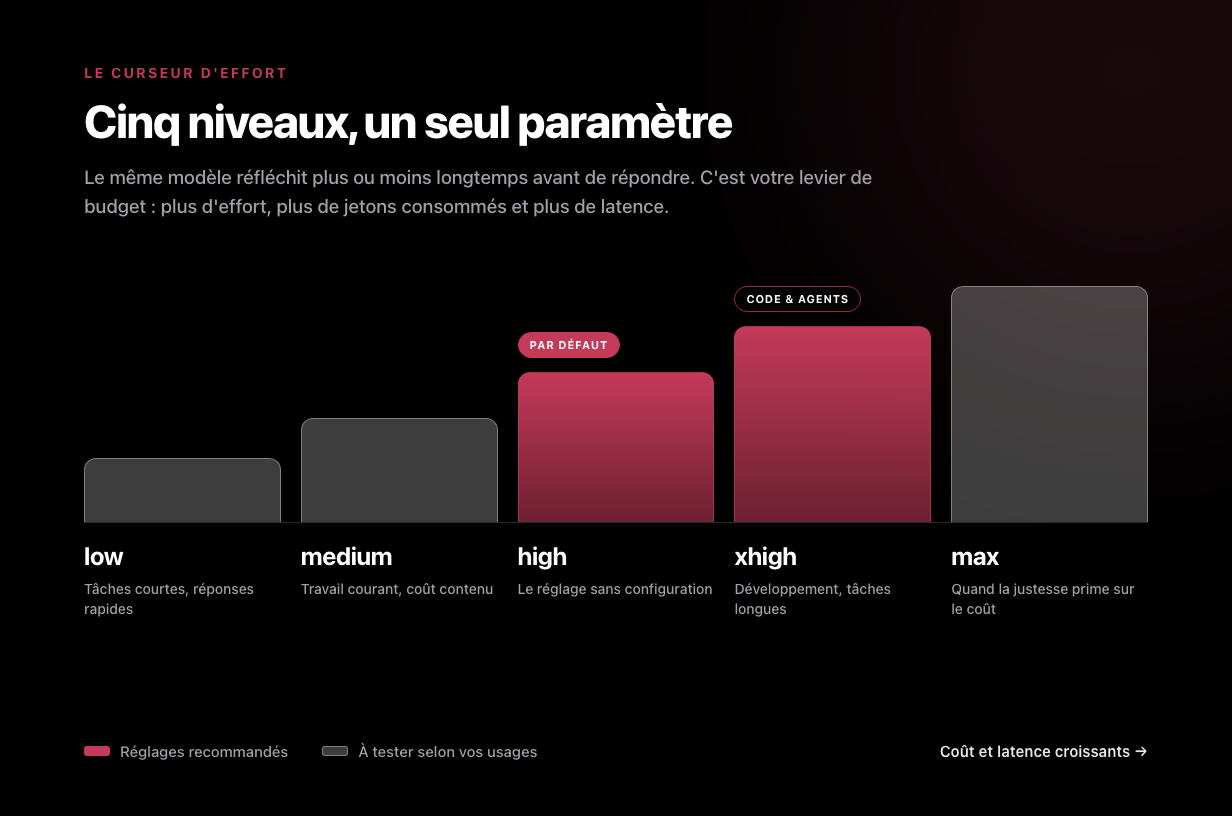
The default level is high, and each additional notch buys more thought against tokens and time.
Anthropic highlights a useful point for a tight budget: the low and medium levels maintain good quality for a fraction of the tokens.
Sorting incoming messages doesn’t need the same setting as a code migration.
- low or medium: classification, extraction, short high-volume responses.
- high: the default setting, suitable for most business uses.
- xhigh or max: technical overhaul, long analysis, autonomous work over several hours.
Another change to know: the model’s reflection is now active by default, whereas it had to be explicitly requested on Opus 4.8.
This reflection consumes output tokens, and a bill can rise without a single line of code changing.
This is exactly the kind of point to have your provider check before a switch, just like choosing between Claude and ChatGPT subscriptions for your teams.
Three questions to ask before confirming a switch
- What portion of our current consumption uses an older model, and what would the real cost be at the same rate?
- Are our repeated prompts cached now that the threshold is down to 512 tokens?
- What effort settings do our automations run on, and have we measured quality at a lower level?
A precise answer to these three questions is worth more than an argument about benchmarks.
A provider who can tell you how much a task costs at your place understands your project better than one who recites scores.
What this model doesn’t solve
A more capable model is still a probabilistic model, producing plausible answers, not certified ones.
Human review on everything going out to a client, supplier, or administration remains a sensible obligation.
Anthropic notes two new behaviors that require adjustment: responses and produced documents are longer by default, and the model checks its work spontaneously.
Verification instructions inherited from previous generations become counterproductive and should be removed from existing prompts.
Switching models without reviewing your prompts is like buying a more powerful car while keeping the old settings.
The fast mode, charged at $10 for input and $50 for output, exists only on the Claude API and not on Amazon Bedrock, Google Cloud, or Microsoft Foundry.
If your infrastructure is hosted by one of these providers, this mode doesn’t concern you today.
Do you need to do anything this week
If you have no ongoing AI project, the answer is no.
If you do, switching a model identifier is a matter of minutes, followed by a verification phase that takes a bit of time.
The right approach is to request a test on a limited scope, with a before-and-after measurement on three indicators: cost per task, result quality, and processing time.
You will then know if the announced gain exists for your use case, which is the only thing that matters.
You can find the raw technical elements in Anthropic’s official announcement and in the model’s new features documentation.
Frequently asked questions
When was Claude Opus 5 released?
Anthropic released the model on July 24, 2026.
How much does Claude Opus 5 cost?
The API rate is $5 per million input tokens and $25 per million output tokens, the same as Claude Opus 4.8.
What’s the difference with Claude Fable 5?
Fable 5 is charged $10 for input and $50 for output, and remains Anthropic’s recommended model for the most demanding tasks, while Opus 5 approaches its results at half the price.
What is the context window size?
It reaches 1 million tokens, both as the default and maximum value, with a maximum of 128,000 tokens for responses.
On which platforms is the model available?
It’s accessible via the Claude API, Amazon Bedrock, Google Cloud, and Microsoft Foundry, plus the public Claude applications.
Should you migrate from Claude Opus 4.8?
The migration is simply changing the model identifier, with two points of caution: reflection is active by default and output token limits need adjustment.
What does the effort level mean?
It’s a five-level setting that determines the model’s depth of reflection, and with it the cost and time of each request.
Does the model cost more to use despite the same rate?
It’s possible if the default active reflection isn’t controlled, as it consumes output tokens billed at a premium.
Is it suitable for a small business without a tech team?
Yes, for use via Claude applications, with a provider’s support when integrating the model into an internal tool.
Should existing prompts be reviewed after the switch?
Yes, by removing unnecessary verification instructions and controlling response length, which is more generous by default in this generation.
Related Articles

Agentik vs Monid: comparing AI agent tools
Connecting an AI agent to the real web quickly becomes like juggling a bunch of keys. A web search here, a scraping tool there, a contact enrichment service, an image…

What is Jev? The AI model that doesn’t generate text
Jev IA, lancé par TypeSafe le 15 septembre 2026, classe et note au lieu d’écrire. Fonctionnement, prix, limites et ce que cela change pour votre logiciel.