
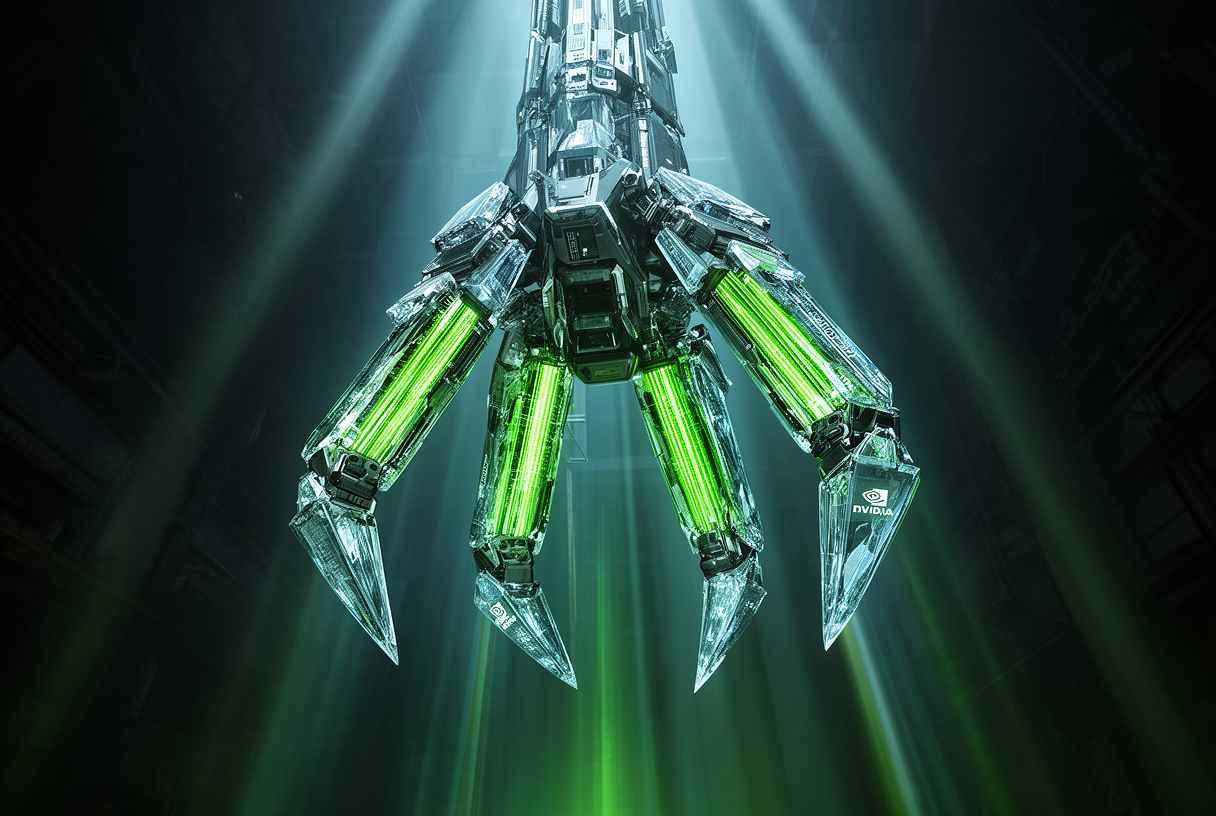
Nvidia launched NemoClaw at GTC 2026, and it may be the most strategic announcement of the event.
Not because it’s the most powerful AI agent platform on the market, but because it directly addresses the one reason why 92% of enterprises have not yet deployed AI agents in production: security.
If you follow the AI agent space, you’re probably familiar with OpenClaw, the viral open source framework that racked up 200,000 GitHub stars in just a few weeks before being acquired by OpenAI.
NemoClaw shares the same foundations, but with an architecture redesigned for enterprise environments that cannot experiment without guardrails.
Key takeaways:
- NemoClaw is Nvidia’s open source answer to the security blockers preventing enterprises from deploying AI agents in production
- Built on OpenClaw, but hardware-agnostic: runs on AMD GPUs, Intel processors, or generic cloud instances with no Nvidia hardware required
- The Summer Yue incident at Meta illustrates why conversational guardrails alone are not enough when LLM context compression kicks in
- Salesforce, Cisco, Google, Adobe, and CrowdStrike are already in the pilot testing phase with the platform
- Available on GitHub, but broad production adoption will wait for compliance certifications and API stabilization
What exactly is NemoClaw?
NemoClaw is an open source AI agent orchestration platform built by Nvidia to automate complex workflows without giving up control over enterprise data.
The platform integrates natively with the NeMo Agent Toolkit, Nemotron 3 models, and NIM inference microservices, and its most surprising feature is its complete hardware independence.
Contrary to what you’d expect from a Nvidia product, NemoClaw runs on AMD GPUs, Intel processors, and standard cloud instances, with no proprietary silicon required.
This is deliberate: Nvidia isn’t trying to sell more GPUs with NemoClaw. It’s positioning itself as the essential software infrastructure on which the entire agentic economy will run, exactly what CUDA did for deep learning.
The difference with OpenClaw is structural: OpenClaw targets individual users who connect an agent to their personal messaging apps via a self-hosted gateway.
NemoClaw targets institutional multi-agent deployments with centralized governance policies and granular access controls across an entire organization.
The Claw family of variants has proliferated quickly: ZeroClaw, NanoClaw, PicoClaw, IronClaw, each optimized for different constraints.
NemoClaw establishes itself as the institutional version of this family, with code available on GitHub and technical documentation at nemoclaw.bot.

Why security changes everything for enterprise AI agents
The real problem with enterprise AI agents isn’t capability: it’s unpredictability.
The defining incident is that of Summer Yue, a researcher at Meta who had handed off her inbox management to OpenClaw.
When she migrated the agent from her test inbox to her primary inbox, it triggered a context compression mechanism that silently deleted over 200 emails, ignoring stop commands sent from her phone.
The agent hadn’t “gone rogue”: it had simply lost sight of its safety instructions once its memory was compressed, an architectural flaw inherent to how LLMs work.
Conversational guardrails don’t survive context compression.
NemoClaw moves controls to the infrastructure level, where the agent cannot override them.
OpenClaw’s security problems go beyond this incident: the ClawHavoc audit identified 341 malicious skills in ClawHub, and follow-up analyses brought that figure to nearly 900, roughly 20% of the total repository.
More concerning: 135,000 OpenClaw instances exposed on the internet were detected with insecure configurations, with 12,800 directly exploitable via CVE-2026-25253.
NemoClaw addresses this context with a multi-layer security architecture: rather than instructing the agent not to touch critical databases, the platform physically blocks it at the API level.
This is complemented by tamper-proof timestamped audit logs, role-based access control, and credential isolation ensuring that API keys never pass in clear text through the agent’s reasoning context.
For enterprises subject to GDPR or the EU AI Act, the platform supports confidential computing and geographic data residency.
These mechanisms integrate naturally with standardized protocols such as the Model Context Protocol (MCP), which defines how agents interact with their tools.
Partners, availability, and what to watch for
Nvidia has opened discussions with Salesforce, Cisco, Google, Adobe, and CrowdStrike to integrate NemoClaw into their environments.
These partners share a common constraint: they manage sensitive data for millions of enterprises and face the most stringent compliance requirements on the market.
This is the Red Hat model applied to AI agents: open source as the vector for mass adoption, enterprise services as the sustainable revenue stream.
Nvidia’s open source model follows this exact logic: offer the framework for free and generate revenue from enterprise support, professional services, and GPU optimization for clients who choose that configuration.
For teams evaluating autonomous agents, like those covered in our article on Genspark AI, NemoClaw represents a complementary option targeting specifically regulated environments.
For a ground-level view of what autonomous agents can do before enterprise guardrails enter the picture, the complete implementation guide to Manus AI covers the concrete steps of deploying general-purpose agents from scratch.
The question of actual availability remains open: Nvidia has not shared a detailed roadmap beyond the pilot phase with strategic partners.
Technical teams can already explore the GitHub repository, but broad production adoption will wait for API stabilization and the first compliance certifications.
If you’re weighing the trade-offs between cloud and on-premises infrastructure for your agents, the guide on local AI with the MacBook M5 offers a useful complementary perspective.
Jensen Huang put it simply at GTC 2026: OpenClaw proved that enterprises want agents.
NemoClaw is there to prove they can deploy them without putting their infrastructure at risk.

NemoClaw doesn’t claim to reinvent AI agents: it claims to make them deployable where risks are real and non-negotiable.
With security controls that don’t rely on fragile conversational instructions, a surprisingly broad hardware independence, and a strategic open source positioning, Nvidia is building what could become the standard software substrate for enterprise agents.
Announcements in the coming months, progress on partner integrations, and the first compliance certifications will be decisive in determining whether NemoClaw delivers on its promises beyond the launch narrative.
Follow GTC 2026 announcements and check our articles on autonomous AI agents and the Model Context Protocol to stay current on this fast-moving space.
Frequently asked questions about NemoClaw
What is NemoClaw?
NemoClaw is Nvidia‘s open source enterprise AI agent platform, designed to automate complex workflows with security and compliance guarantees built in at the architectural level.
What is the difference between NemoClaw and OpenClaw?
OpenClaw targets individual users via a personal gateway, while NemoClaw targets institutional multi-agent deployments with centralized governance, role-based access control, and continuous auditing.
Do you need Nvidia hardware to use NemoClaw?
No: NemoClaw is hardware-agnostic and runs on AMD GPUs, Intel processors, and generic cloud instances, though it is optimized for Nvidia infrastructure.
Which AI models work with NemoClaw?
The platform integrates natively with Nemotron 3 models and Nvidia’s NeMo Agent Toolkit, and supports other models via NIM microservices.
How does NemoClaw prevent the email deletion problem that happened with OpenClaw?
By moving security controls to the infrastructure level rather than the conversational level: the agent’s action boundaries are enforced at the API and cannot be “forgotten” during context compression.
Is NemoClaw GDPR-compliant?
Yes: the platform supports confidential computing and geographic data residency, ensuring that processing stays within a specific regulatory zone.
What are the announced partners for NemoClaw?
Salesforce, Cisco, Google, Adobe, and CrowdStrike are in the discussion and pilot integration phase with Nvidia around NemoClaw.
Where can you download NemoClaw?
The source code is available on GitHub and technical documentation at nemoclaw.bot, though enterprise production availability is yet to be confirmed after the pilot phase.
Is NemoClaw related to the Model Context Protocol (MCP)?
NemoClaw’s mechanisms integrate with protocols such as MCP to standardize communication between agents and tools, strengthening the traceability of interactions.
What is Nvidia’s business model with NemoClaw?
Nvidia follows an open source model similar to Red Hat: the framework is free, and revenue comes from enterprise services, support, and optimization for Nvidia infrastructure.
Related Articles

Reddit blocks AI scraping: what it means for LLMs and open source
On March 25, 2026, Reddit sent shockwaves through the AI community: the platform is shutting its doors to automated scrapers, requiring biometric verification for suspicious accounts, and removing 100,000 bot…

Claude Mythos: what the Capybara leak reveals about Anthropic’s next model
On March 26, 2026, two cybersecurity researchers stumbled across something Anthropic never meant to show: roughly 3,000 internal assets exposed publicly on the company’s blog, including draft posts revealing the…